
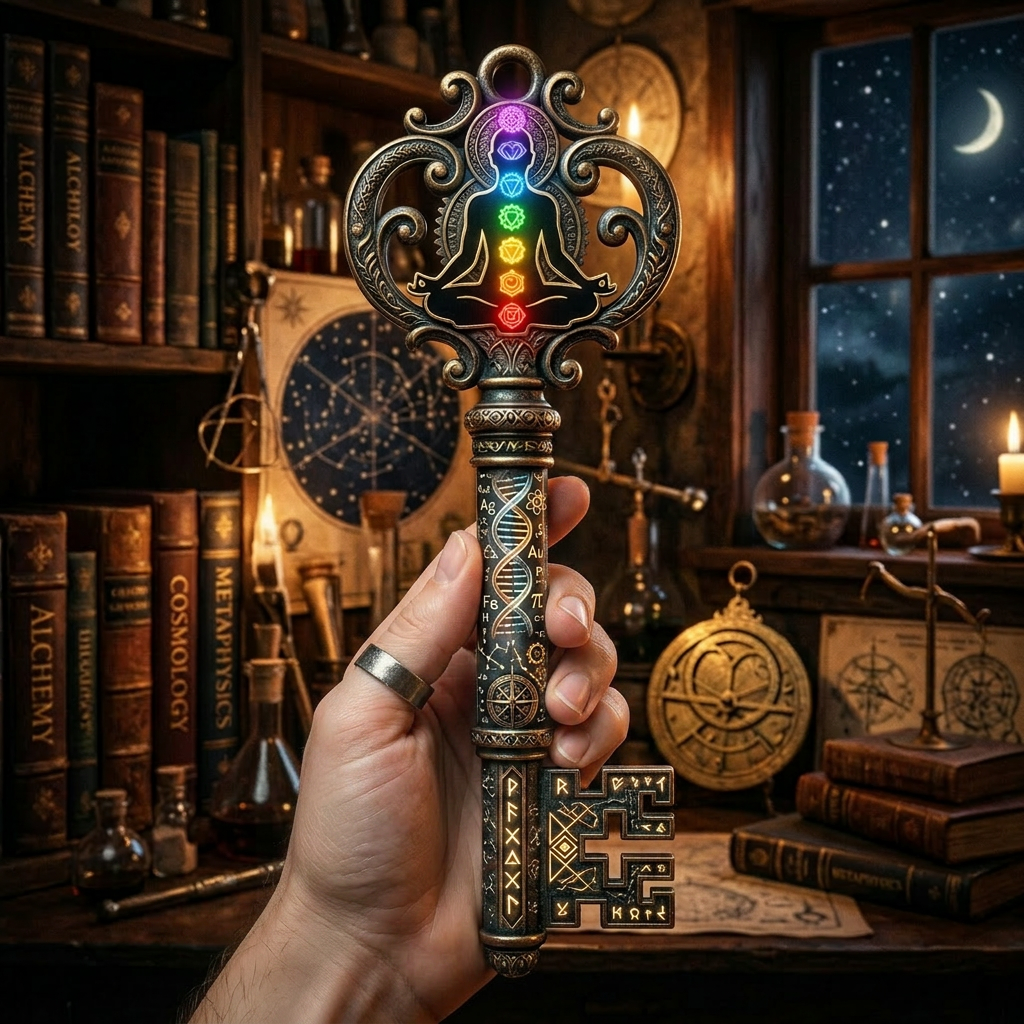
What’s real, what’s promising, and what’s… cautiously optimistic
“528 Hz will repair your DNA.”
“396 Hz will ground your root chakra.”
“Play this tone and your thyroid will align itself.”
There’s a lot of noise in the “healing frequency” world.
It sounds great (pun intended).
It’s also… not all supported by good science.
But here’s the part a solid skeptic might miss:
Sound does affect the body.
We should absolutely be skeptical.
But we should also stay open-minded.
So let’s break it down.

🌊 What sound actually does to the body
Sound isn’t just something you hear.
It’s mechanical vibration.

And your body responds to it in three very real ways:
🧠 1. Nervous system regulation
Sound can shift your autonomic nervous system
(the balance between stress and relaxation).
- slow, harmonic sound → calming response
- chaotic, irregular sound → alerting response
This is one of the most consistent findings across research.

When sound becomes predictable and immersive,
the body tends to interpret that as safe.
And when the body feels safe, a number of processes begin to shift—
in ways you can feel immediately, and sometimes cumulatively over time.
🧠 2. Brainwave effects
Repetitive sound can influence brain activity.

This is where things like binaural beats come in:
- two tones → the brain perceives a third “beat”
- associated with:
- reduced anxiety
- improved attention
- better focus
The effects aren’t dramatic.
But they’re consistent enough that this is one of the more credible areas of frequency-based research.
🌊 3. Direct physical vibration
The physical vibration is real—not just something you “feel emotionally.”
Low-frequency sound can actually vibrate tissues in the body.

Not metaphorically. Physically.
In fact, medicine already uses vibration in much more direct ways than a sound bath.
In one clinical trial using a vibrating capsule:
- 40.7% of patients improved bowel function
- compared to 22.7% with placebo
That’s nearly double the response rate.
Translation:
The body can respond to vibration in very real, physical ways.
🧠 So what do actual studies show about “healing frequencies”?
Let’s look at the ones people talk about most.
🎵 432 Hz vs 440 Hz
This is one of the few places where we have controlled comparisons.
Some small studies suggest that music tuned to 432 Hz may:
- lower heart rate (by a few beats per minute)
- slightly reduce blood pressure
- increase relaxation compared to standard 440 Hz tuning
Not magic. But measurable.

🎵 528 Hz (the one everyone’s talking about)
This one gets a lot of hype—and to be fair, there is one interesting study.
In a small group of 9 participants, after just a few minutes of listening:
- cortisol dropped by roughly 40%
- oxytocin nearly doubled
- mood improved
That’s… a big shift.

Oxytocin is often called the body’s “connection hormone.”
It’s released during moments of bonding—like touch, trust, eye contact, and meaningful social interaction—and is associated with feelings of safety, closeness, and emotional warmth.
It’s also linked to empathy and prosocial behavior—helping us feel connected to other people.
So if a sound experience increases oxytocin…
that’s not just relaxing.
That’s the body shifting toward connection.
But we have to be disciplined here.
This study was:
- very small
- not widely replicated
So this falls into the category of:
“interesting signal, not established fact.”
Binaural beats (the most credible frequency research)
If you’re looking for something with stronger scientific footing, this is it.
Across multiple studies and reviews:
- small-to-moderate reductions in anxiety
- modest improvements in attention and focus
Again—not dramatic.
But repeatable enough to take seriously.

And importantly:
Not all studies show an effect.
Some show little to no difference from control groups.
Which tells us something important:
These effects are real—but not universal.
They depend on:
- the individual
- the frequency
- the duration
- the context
🧘 Sound baths & singing bowls
This is where things get really compelling.

In one study of 62 adults, after a single session:
- tension dropped
- anger decreased
- fatigue decreased
- depressed mood decreased
And here’s the fascinating part:
People who were new to sound baths showed the biggest improvements.

A broader review of available studies found a consistent pattern:
- reduced anxiety
- reduced depression
- reduced tension and anger
- lower heart rate and blood pressure
But also noted:
- very small number of studies
- inconsistent methods
- need for better research
Even smaller pilot studies add to the picture:
In one 25-minute crystal bowl session:
- depression scores dropped immediately after

Again:
- small sample
- early-stage
But pointing in the same direction.
Do frequencies affect specific organs?
This is where we need to stay intellectually honest.
There is no strong supporting evidence that:
- “this exact Hz heals the thyroid”
- “this frequency targets the bowel”
- “this tone repairs DNA”
That idea comes from real physics—resonance—
but gets oversimplified in wellness culture.
Resonance is a basic principle of physics—when something vibrates more strongly at certain rhythms.
You see it when a swing goes higher with the right timing, or when a singer can shatter glass.
The body can also transmit and respond to vibration—but not as a set of perfectly tuned organs with one exact frequency each.
Instead, it behaves more like a fluid, adaptive system, responding broadly to patterns of sound rather than one precise note.
✅ But there are real physiological effects
Just not in that one-to-one way.
Sound can influence:
- heart rate and heart rate variability
- brain activity and attention
- stress hormones like cortisol
- bonding-related signals like oxytocin
👉 So it’s less:
“this frequency heals this organ”
And more:
“this sound experience shifts the system that regulates the organ.”
💛 What about emotions—calm, anger, connection?
This is actually one of the strongest areas of evidence.

Sound directly influences:
- the limbic system (emotion center)
- the vagus nerve (safety vs threat)
Across studies, sound-based interventions show:
- reduced anxiety
- reduced anger
- improved mood
- increased relaxation
Why?
Because the brain is constantly asking:
“Am I safe right now?”
And sound helps answer that question.
- predictable, harmonic sound → safety
- chaotic, dissonant sound → threat
That can be why:
- chanting feels bonding
- drumming feels trance-like
- lullabies calm instantly
🌀 So what about chakras and “healing frequencies”?
Here’s the honest answer:
Sound doesn’t heal the body by targeting specific organs like a laser.
It works by shifting the systems that regulate everything:
- your nervous system
- your hormones
- your brain rhythms
Some frequencies—like 432 Hz or 528 Hz—may show measurable effects.
But the deeper power of sound isn’t in a single number.
It’s in:
- rhythm
- repetition
- coherence
- immersion
When sound becomes predictable and harmonic,
the body interprets it as safe.
And when the body feels safe…
it starts doing what it already knows how to do.

⚖️ One last thing worth saying
Not every study shows strong effects.
Some show modest changes.
Some show little difference from control groups.
That doesn’t mean sound does nothing.
It means its effects are context-dependent—
shaped by the person, the setting, and the experience itself.
💛 If you want to go deeper…
I put together a chakra-organized, evidence-layered breakdown
that separates:
- what’s strongly supported
- what’s emerging
- and what’s still… beautifully speculative
I’ll immediately send you my Sound Frequency by Chakra Completely Free PDF.
The more extraordinary the claim, the more we look for replication, larger sample sizes, and mechanisms that make physiological sense.
This field is still early—but the signal is there.
🧾 Notes & References
- Goldsby TL, Goldsby ME, McWalters M, Mills PJ.
Effects of Singing Bowl Sound Meditation on Mood, Tension, and Well-being: An Observational Study.
Journal of Evidence-Based Integrative Medicine (2017).
– 62 participants; single session associated with significant reductions in tension, anger, fatigue, and depressed mood.
– - Landry JM.
Physiological and Psychological Effects of a Himalayan Singing Bowl Meditation Session: A Systematic Review.
Complementary Therapies in Medicine (2020).
– Review found consistent improvements in anxiety, depression, and stress markers, but noted small sample sizes and methodological limitations. - Hirai K et al.
Effect of 528 Hz Music on Endocrine System and Autonomic Nervous System.
Health (2018).
– In a small study (n=9), cortisol decreased ~40% and oxytocin levels increased after short exposure to 528 Hz music. - García-Argibay M et al.
Efficacy of Binaural Auditory Beats in Cognition, Anxiety, and Pain Perception: A Meta-Analysis.
Psychological Research (2019).
– Found small-to-moderate effects on anxiety, attention, and cognition; results varied depending on protocol. - Rao SS et al.
A Novel Vibrating Capsule for Chronic Constipation: A Randomized Controlled Trial.
Nature Medicine (2023).
– 40.7% of participants improved bowel movements vs 22.7% placebo. - Kalyani BG et al.
Neurohemodynamic Correlates of “OM” Chanting: A Pilot Functional MRI Study.
International Journal of Yoga (2011).
– Demonstrated deactivation of limbic brain regions and increased parasympathetic activity. - Matsuhashi M et al.
Sound Stimulation Induces Gene Expression Changes in Cells.
Kyoto University Research (2018).
– Sound exposure altered expression of 42–145 genes depending on duration; mechanism likely mechanical signaling (mechanotransduction).
If this piece resonates, subscribe to get notifications of new releases.
Leave a Reply