The Double Slit Experiment Explained Simply: Why Reality Isn’t as Solid as We Thought

Reality Isn’t as Solid as We Thought

For a long time, we believed the universe was like a giant machine.

An artistic depiction of a vintage scientific setup featuring an astrolabe, an hourglass, and an open book on a wooden table, surrounded by swirling cosmic patterns and glowing orbits, with the text overlay: 'Tiny solid pieces moving in predictable ways. If you knew enough, you could calculate everything.'

Then scientists performed a simple experiment.

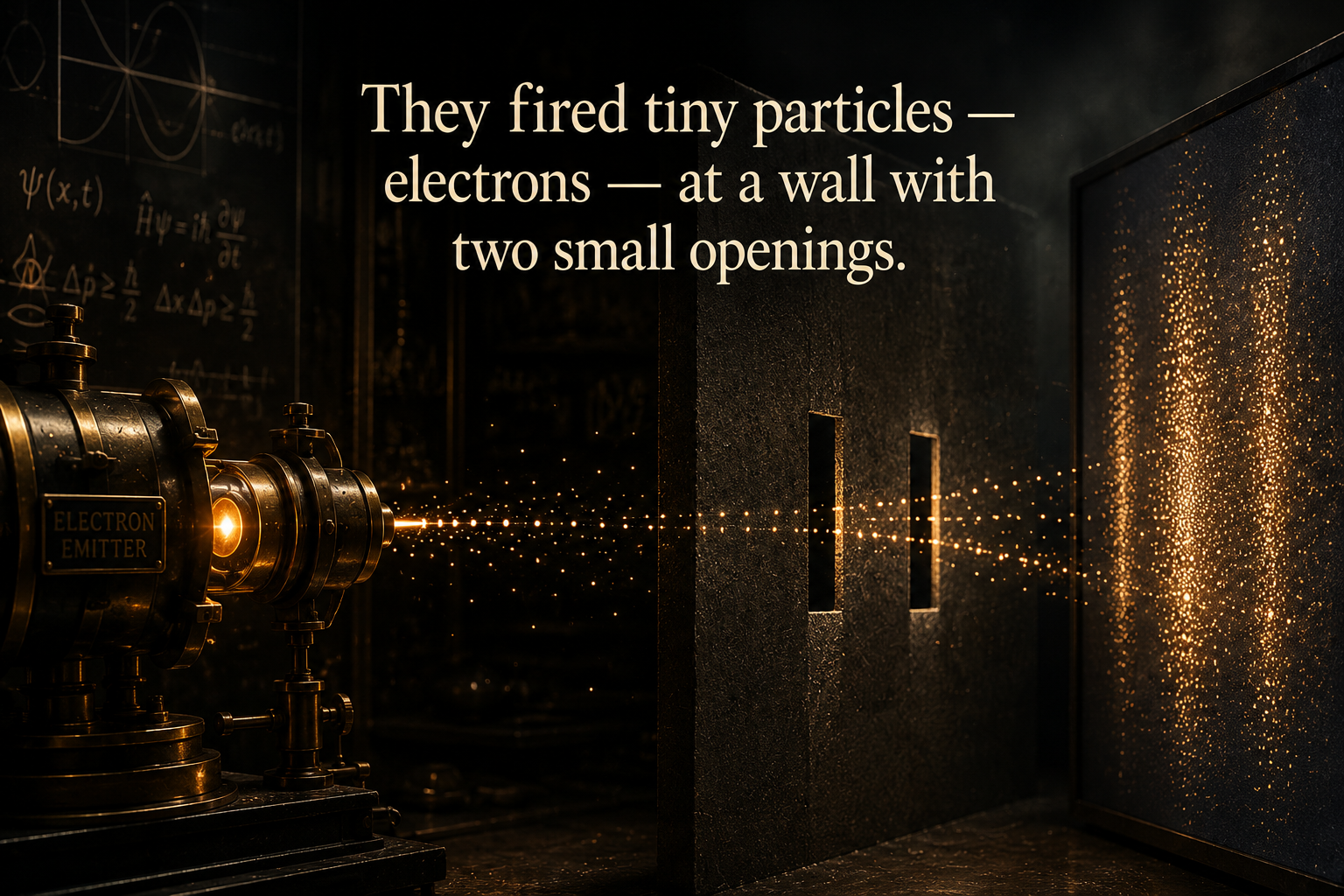
Illustration of electrons being fired at a barrier with two openings, showing the resulting pattern on the wall behind the barrier.

If electrons were just tiny solid balls, they would go through one slit or the other and leave two neat lines on the screen behind.

But that’s not what happened.

When no one measured which slit the electron passed through, the pattern on the screen looked like waves overlapping — like ripples in water.

Illustration of electrons being fired at a double slit, depicting wave-like behavior as they create an interference pattern, with descriptive text about quantum physics.

But when scientists placed a detector at the slits to check which path the electron took, the wave pattern disappeared.

An illustration showing a particle, depicted as a small light, passing through two slits and producing two distinct lines on a screen, symbolizing particle behavior in physics.

The difference?

Illustration explaining the concept of measurement in quantum physics, showing an electron behaving like a wave without interaction and like a particle with interaction.

This doesn’t mean human thoughts magically create reality (necessarily).

It means that at very small scales, reality is not fixed in the way we once imagined. Instead of solid certainty, there are probabilities — possible outcomes — until interaction narrows them down.

What this experiment shows us is not mystical power.

It shows us humility.

An abstract visual representation illustrating the concept that the universe is made of relationships, probabilities, and interactions, rather than solid building blocks. The image features wavy lines and glowing elements, emphasizing the themes of interaction and uncertainty.

And we are not outside of that system.

We are inside it.

An artistic representation exploring the concept of stability and mystery at different scales, featuring a chair, abstract particle designs, and flowing waves against a dark background.

The universe is not chaos.

But it is not rigid either.

It is structured — and relational.

A graphic displaying the text about the implications of reality being deeper, more subtle, and interconnected, featuring illustrations of a chair, network patterns, and waveforms.

That alone is enough to soften certainty.

And soften certainty is the beginning of humility.

What We Pay Attention To

The double slit experiment does not prove that human thought creates physical reality. I’m not saying it does.

But it does remind us of something quieter:

Interaction matters.

An infographic explaining the concept of measurement in quantum mechanics, showing the transition from multiple possibilities before measurement to a single outcome afterward. It features sections on observing, engaging, and influencing, with corresponding visual elements and text.

In our human lives, attention works in a different ~ but still meaningful ~ way.

An illustration depicting concepts of focus, dwelling, and practice in relation to perception, featuring visual representations that become clearer over time, against a dark background.

Neuroscience calls this reinforcement.
Psychology calls it pattern formation.
We might simply call it attention shaping experience.

An infographic illustrating the effects of focusing on threats versus gratitude, showing the brain's reinforcement of what it looks for and how this influences one's perception of the world.

The external world does not rearrange itself because you wish it to (necessarily).

But your lived experience of it shifts based on what you observe, interpret, and reinforce.

In that sense, observation has consequences.

The double slit experiment teaches us that reality at its foundation is not a rigid, detached machine. It is shaped through interaction.

In our own lives, we are not passive spectators either.

We are constantly participating through attention.

An infographic illustrating 'The Cycle of Participation,' detailing how participation shapes individual growth. It includes five stages: directing attention, engaging with significance, reinforcing patterns, shaping perception, and transformative participation. The design features cosmic imagery symbolizing influence and interconnectedness.

If reality is more mysterious than we once believed, perhaps certainty deserves a softer grip.

Humility isn’t self-diminishing. It’s accurate perspective inside a vast and intricate universe.

A serene scene of a woman sitting at a stone table, holding a teacup, looking out over a picturesque landscape at sunset. The text overlay promotes a free guide on humility with the subtitle 'The quiet strength behind a meaningful life.'

Discover more from Humility Key

Subscribe to get the latest posts sent to your email.


Comments

Leave a Reply

Discover more from Humility Key

Subscribe now to keep reading and get access to the full archive.

Continue reading