
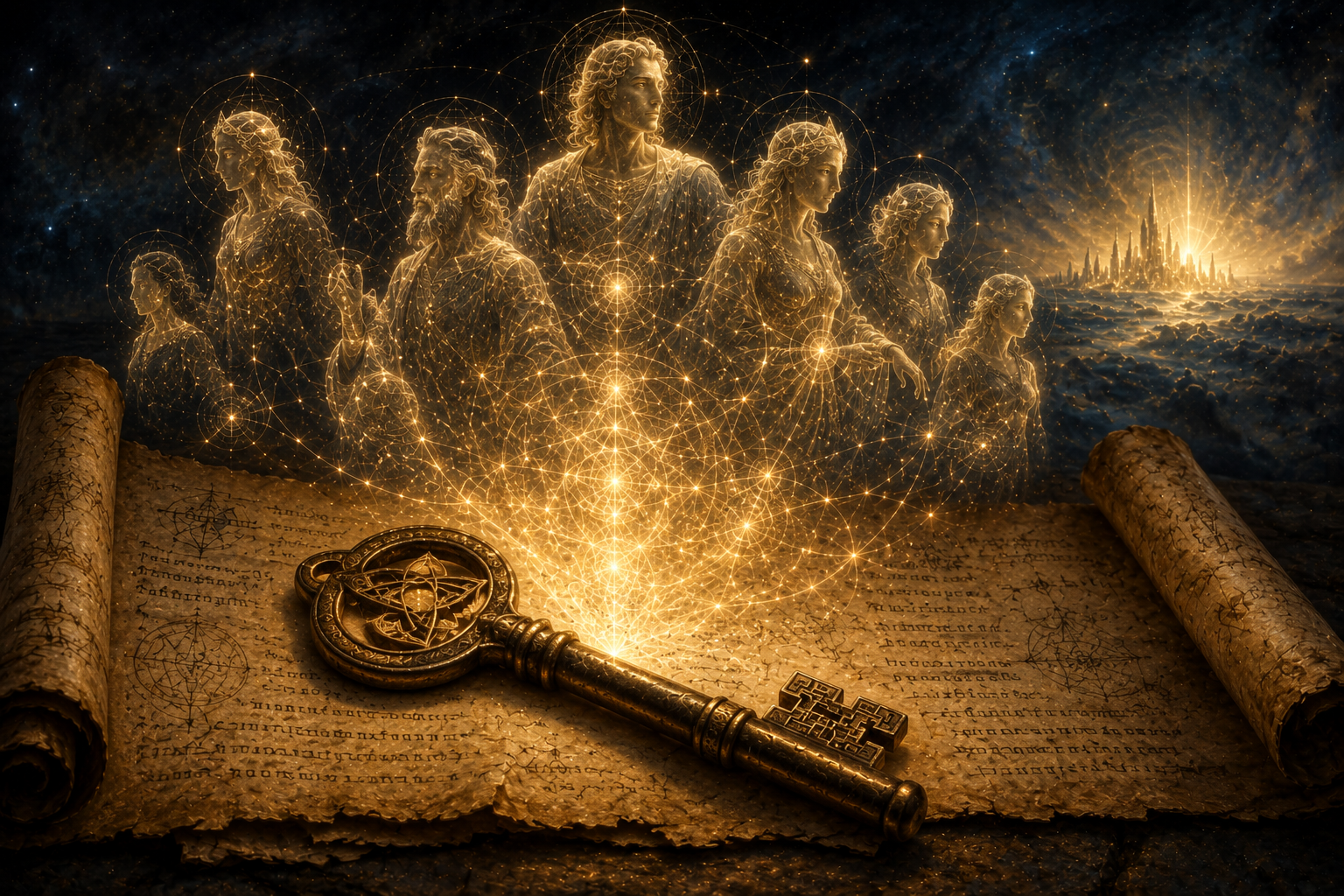
The Gnostic Creation Tale. This article focuses on the manifestation up to during Sophia. Before the Demiurge. Before the Garden. Before the divine spark trapped in humanity.
We have to begin much earlier, in a place so strange that even calling it a “place” feels inaccurate. Before creation itself.
One last disclaimer before we begin. Gnosticism was never a single unified tradition. The story that follows draws primarily from Sethian texts such as the Apocryphon of John while occasionally borrowing language and themes more commonly associated with Valentinian thought. Important disclaimer: this is not merely a retelling. The cosmology belongs to the Gnostics. The speculation is mine.

There was the Pleroma. The Fullness.
This is not a man in the clouds in a mystical kingdom on a throne. The Gnostics imagined something far more mysterious: an ultimate reality beyond all categories.
Before light and darkness.
Before good and evil.
Before male and female.
Before spirit and matter.
Before anything could be divided into this or that.
There was only the Whole. So full that language struggles to describe it. The ancient texts often refer to the source as the Invisible Spirit—the unknowable origin from which everything emerges. Not a being among other beings, but the ground of being itself.
And then the remarkable happens. The Source does not create. It emanates.
This nuance matters. A carpenter creates a chair. The chair is separate from the carpenter. But the sun does not create sunlight. Light radiates naturally from what the sun is. The Gnostics imagined reality unfolding in a similar way. The Infinite overflows. And from that overflowing emerges the first great mystery.
Barbelo.

If Sophia is the famous daughter of the story, Barbelo is its forgotten queen. The first thought. The first image. The first reflection of the Invisible Spirit. The texts call her Forethought, the Womb of the All, the First Thought of the Father.
Even now, scholars debate exactly what Barbelo represents. Is she a goddess? Divine consciousness? Is she the first movement toward self-awareness? The language shifts depending on the text.
What remains constant is her importance. Nothing unfolds without her. The unknowable becomes knowable through Barbelo.
What struck me when I first encountered this part of the story was how little urgency there was.
Nothing is being built yet.
No worlds.
No stars.
No humans.
No gardens.
No catastrophe.
No Demiurge.
Just qualities.
As though the universe is assembling its ingredients before it begins cooking.
The Apocryphon of John names four attributes received by Barbelo: Foreknowledge, Incorruptibility, Eternal Life, and Truth. What follows is my attempt to sit with what those words might mean.

The names sound abstract at first, almost sterile. Like concepts from a philosophy textbook. However, the longer I sat with them, it seems clear that these are not possessions, they are conditions.
The architecture upon which everything else will eventually rest.


Foreknowledge appears first, which, immediately my modern brain wants to translate into prediction. Knowing the future. But there’s more nuance to it. The word seems to point toward something deeper. It’s having the framework already in place. Having just the right orientation to see the larger picture. A sense that reality possesses an underlying coherence even before anything has happened.
Then comes Incorruptibility. A quality I find unexpectedly moving. Because corruption requires:
- Division
- Time
- Distance from the source
- Decay
- Fragmentation
- Misunderstanding
But here, at the beginning of things, none of that exists yet. The story seems to be describing a reality so close to its origin that distortion has not yet become possible.
Then Eternal Life. Not immortality at least not in the way we usually imagine it. The Gnostics do not appear interested in endless survival. They seem interested in something more fundamental. Life itself. Life before birth and death, clocks, or any categories really. The essence of life.
And then Truth. Which arrives last… except “arrives” is the wrong word. Nothing here feels sequential. Truth emerges because Truth has always been present. It simply becomes visible.
The story unfolds more like a flower opening than a machine assembling.
The more I sat with these attributes, the more they began to feel less like divine gifts and more like dimensions, or the operating principles of reality itself. Or perhaps a better way to put it… different layers of the atmosphere of ‘heaven’.

The atmosphere of heaven before heaven becomes populated.
Only after these qualities are established does the story continue. Only then does the architecture become more elaborate. Only then do further emanations emerge. Only then do we begin moving toward the world we recognize.
Toward differentiation. Toward Sophia. Toward the great drama that follows.
But for a moment, the story pauses here. In stillness. As though the ancient writers wanted us to understand something before we continued.
Before there can be creation, there must be orientation.
Before there can be experience, there must be structure.
Before there can be a story, there must be Truth.
And somewhere in the strange silence between Barbelo and Sophia, the universe seems to be gathering itself for what comes next.
Autogenes — The Self-Generated One
The atmosphere had been established. The architecture of everything was complete. The conditions existed for something new to emerge. And from the relationship between the Invisible Spirit and Barbelo came Autogenes.
The Self-Generated One.

Even the name feels strange. Autogenes.
- Self-generated.
- Self-begotten.
- Self-created.
The words resist easy understanding. How can something be generated and self-generated at the same time? How can something emerge while already containing its own source? The Gnostics are remarkably comfortable with incongruency. If there’s a paradox, the Gnostics are IN. They seem to consider it a feature rather than a bug.
The texts often describe Autogenes as:
- first great manifestation of divine consciousness.
- The firstborn.
- The first luminous expression.
- The first center around which the rest of the heavenly order begins to organize itself.
- Some traditions identify him with the heavenly Christ.
- Others emphasize his role as the first self-aware emanation.
Either way, something important has happened. The architecture now has an inhabitant. The atmosphere now has a “living” center.
And this is where the story begins to feel less like theology and more like a lovely little side dream. Because from Autogenes emerge four extraordinary beings known as the Luminaries. The Four Lights. The Four Illuminators.
The ancient lists assign specific powers and realms to each Luminary; what follows is my symbolic reading of how those names feel inside the larger story.
The names are every bit as strange as you would hope.

I wish I could tell you exactly what they are. Angels feels wrong. Gods feels wrong. People feels wrong. The closest description might be realms of consciousness personified. Living principles or divine intelligences. Facets of heavenly order.
The language becomes increasingly symbolic. The map increasingly dreamlike.


The more I read about the Four Luminaries, the less they feel like characters and the more they feel like… stations within consciousness. Looking back on your life you can recognize different levels of realizations and movements within those awakenings. What life looks like when you’re 8 years old. What life looks like at 22, equally lost yet somehow disproportionately excited somehow. At 50, maybe learning forgiveness for the first time or loss for the millionth time. Still you. Still One. Never separate from you.
Levels of realization. Movements within awakening. Not separate from the Source. Expressions of it.
The One becoming Many without ever ceasing to be One.
As the heavenly order continued unfolding, a pattern began to emerge. The Gnostics called these pairings syzygies.
- Consorts.
- Divine counterparts.
- Not opposites.
- Complements.
The universe, they believed, unfolds through relationship. One principle revealing another. One completing another. One impossible to fully understand without the other.
- Depth and Silence: Bythos and Sige
- Mind and Truth.
- Word and Life.
- Humanity and Assembly.
- Will and Wisdom.
We’ll go through these pairs one by one.
Bythos and Sige: Depth and Silence


Depth + Silence = Presence
Nous and Aletheia: Mind and Truth
This one feels completely different.


Mind + Truth = Recognition or Understanding.
Which makes me wonder if the pairs aren’t generating harmonies after all.
Maybe they’re generating frames of mind.
Logos & Zoe: Word & Life

At first glance this sounds simple. Speech and biology. Language and breathing. We get it, right?
But I think the Gnostics meant something much bigger.

Word + Life = Creation
Which is fascinating because this is exactly what artists do.
- And writers.
- And parents.
- And gardeners.
- And teachers.
- And honestly…
- God.

And reality appears between them.
This makes me further speculate… the Aeons are representations of living processes (or they ARE living processes, if you like that direction)—patterns of relationship through which reality continually comes into being.
Now the next pair gets really juicy.
Anthropos & Ecclesia: Humanity & Assembly

This one is sneaky. The obvious interpretation is “Individual vs Group”. But upon closer examination, I think we can go deeper. What does the harmony of ‘Individual and Group’ make? Consider this: “Individual through Group”.

The individual discovers themselves through relationship. The community discovers itself through individuals. Neither can fully exist without the other. The harmony produces: Meaning.
And now we arrive at the big one.
Theletos & Sophia: Will/Desire & Wisdom

This is the pair that makes the entire myth work. Because this is the pair that eventually ‘breaks’.

Will alone becomes impulsiveness. It’s action without understanding. Movement for the sake of movement. Power without harnessed direction. Wisdom alone becomes contemplation. Insight without embodiment. Understanding without participation. Knowledge that never enters the world.
But together?
The harmony produces: Right Action. Creation with purpose and intention, aligned with our best selves, moving in accordance with reality.
Which suddenly makes Sophia’s story highly interesting.
Because if the previous pairs produce:
- Presence.
- Understanding.
- Creation.
- Meaning.
Then Will and Wisdom produce:
Integration.
The capacity to act from understanding. The ability to embody what is known. Not merely to see the path… To walk it. Not merely to recognize truth… To live it. Not merely to possess wisdom… To express it through action.
Will provides the movement. Wisdom provides the direction. Between them is the moment understanding physically enters the world.

And when Sophia reaches beyond her consort… the thing that breaks isn’t merely a rule.
- The dance breaks.
- The relationship breaks.
- The creative tension breaks.
And the myth asks: Can wisdom create alone?
The answer seems to be:
Something emerges.
But not wholeness.


Again and again, reality appears not in isolation, but in relationship. The more I follow the pattern, the more I wonder if the Gnostics were pointing toward this: Perhaps the Aeons are not merely beings. Perhaps they are living processes. Perhaps they are relationships through which reality comes into being.
And if that is true, perhaps the same is true of us. We are not nearly as separate as we imagine. No one becomes fully themselves alone.

And perhaps, as the mystics have always suggested, through relationship with something greater than ourselves.
A Higher Power.
God.
The Tao.
The Great Mystery.
Whatever name we choose.
Following the pattern further, I wonder if the meaning of life is not to find ourselves, but to create ourselves through harmonic participation. Toward discovering that what appears separate is somehow already connected. That ‘who we are’ emerges not in isolation, but in relationship.
I am reminded of an old saying, often attributed to William Blake:

And if there is any wisdom hidden within the Pleroma, perhaps it is this:
What is most real is not the parts. It is the living harmony between them.
The dance itself.
That detail matters.
Because eventually one Aeon will attempt to act without her counterpart. And when she does, the story changes forever. The next part of the story… coming soon. Subscribe and get notifications of new releases.


This article draws primarily from Sethian sources, particularly the Apocryphon of John, while occasionally borrowing language and themes from Valentinian traditions. The cosmology belongs to the Gnostics. The speculation is mine.

Leave a Reply