
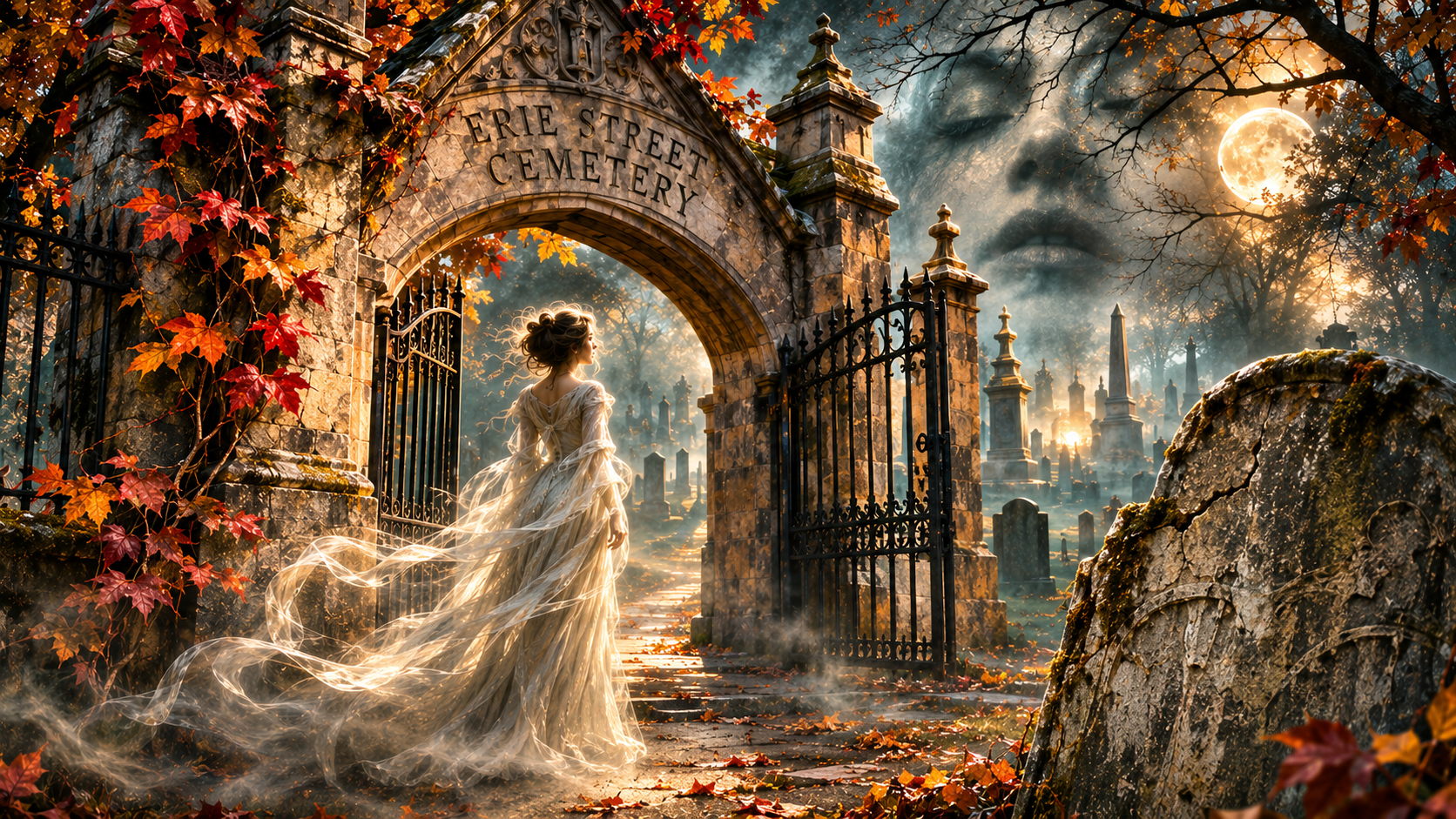
Erie Street Cemetery, Cleveland, Ohio
Cleveland has a bit of a habit of renaming things. Take 1906, the city decided to replace many of its street names with numbers. Erie Street became East Ninth Street. A perfectly reasonable administrative decision, intended to make a rapidly growing city easier to navigate.
Unfortunately, somebody forgot to tell the cemetery.

The street changed its name. The cemetery kept its own. Considering everything the city subsequently tried to do to the place, that may have been its first successful act of defiance. Because the story of Erie Street Cemetery isn’t just about the dead who won’t leave.
It’s about the living who keep trying to make them.
A Dollar, a Daughter, and a Very Inconvenient Location
In 1826, Cleveland was still a rather ambitious little settlement on the southern shore of Lake Erie. It had been burying its dead in a modest graveyard near Public Square, along Ontario Street. But as the population grew, so did the need for additional burial space. The original cemetery was becoming crowded and increasingly unsuitable for a developing commercial center.

The property would become the City Cemetery, later known as Erie Street Cemetery. And although Cleveland’s municipal records describe approximately eight acres, historical accounts sometimes describe the grounds as nearly nine, or even larger during certain periods of expansion.
The distinction is not especially troubling. The property changed over time, and nineteenth-century Cleveland was not particularly good at leaving anything alone.
What mattered was its location. The cemetery stood on the outskirts of the settlement, surrounded by enough undeveloped land to accommodate generations of future burials. Surely nobody would ever need that property for anything else…
In September 1827, four-year-old Minerva M. White, daughter of Moses and Mary White, became the cemetery’s first recorded new burial. Her father, Deacon Moses White, was an influential figure in Cleveland’s early religious life. He helped establish some of the community’s first religious schools. Minerva’s death was one of several tragedies endured by the White family.
Contemporary historical accounts also preserve a rather peculiar complaint: residents reportedly considered the new cemetery terribly inconvenient because it was so far away from town. Imagine the indignity. A grieving family had buried their little girl, and the neighbors were upset about the commute.

But there is another complication.
Minerva was the first recorded new burial, not necessarily the first human being whose remains reached the property. Bodies from the older Ontario Street burial ground were transferred to Erie Street as Cleveland expanded. Some had been buried years before the new cemetery existed.
Even at the beginning, then, Erie Street was receiving people whose resting places had already been disturbed. An unfortunate precedent.
The Dead Had Company
In 1836, the city apparently looked at all that unused cemetery property and decided that a few additional municipal facilities couldn’t hurt.

By 1840, the cemetery was receiving improvements. Its grounds were replanted, burial plots reorganized, and systematic burial records established. Earlier records had been considerably less thorough. An unsettling thought when contemplating the thousands of people who would eventually occupy the grounds.
That year also brought a revealing episode in Cleveland’s religious history. On April 1, 1840, Jewish community leaders petitioned the city for a designated section of Erie Street Cemetery. The request was denied. The community subsequently established Willett Street Cemetery across the Cuyahoga River.
Even in death, Cleveland’s residents were negotiating who belonged where. The city’s growth continued.
In 1853, Woodland Cemetery opened as a new municipal burial ground. But Erie Street remained an important resting place for Cleveland’s earliest families.
And it had not yet received the greatest tragedy it would be asked to remember.
The Ship That Burned Before Dawn
In the early morning hours of June 17, 1850, the wooden steamship G. P. Griffith was making its way across Lake Erie. The vessel had departed Buffalo, bound for Toledo, carrying hundreds of passengers. Many were immigrants from Germany, Ireland, England, and other European countries, traveling west in search of better lives.

Instead, just before dawn, disaster struck. At approximately three o’clock in the morning, fire broke out near the vessel’s two smokestacks. The precise cause remains disputed. Some accounts blame sparks around the smokestacks. Others suggest flammable paint or oil near the machinery, or dangerous cargo that ignited.
Whatever started the fire, the flames spread rapidly through the wooden steamer. Passengers awoke to smoke, heat, confusion, and the terrible realization that their ship was burning in the middle of Lake Erie.
The captain attempted to reach shore. But the Griffith struck shallow water near the shoreline, still too far away for many passengers to escape. People jumped into the lake. Some could swim. Many others could not and the money carefully sewn into their clothing, intended to secure their future, may have made swimming even more difficult. Within a short time, the steamship was destroyed.
Estimates of the dead range from approximately 241 to 289 people, making the Griffith one of the worst maritime disasters in Great Lakes history and among the deadliest ever recorded on Lake Erie. The exact number remains uncertain because passenger records were destroyed and not everyone aboard could be identified.
Most victims recovered near the wreck site were buried in a mass grave along the lakeshore near present-day Willowick. Other remains were brought to Cleveland, where some were interred in an unmarked communal grave at Erie Street Cemetery. The cemetery’s Ohio historical marker acknowledges that burial.

Curiously, the marker dates the Griffith disaster to 1847. The ship was launched in 1847. It burned on June 17, 1850. So even the official historical marker has managed to introduce a little confusion into the story.
History is like that. Somewhere beneath Erie Street Cemetery are people who boarded a ship believing they were traveling toward their future. They never reached it. Their names are not all known.
And the city continued growing around them.
The Dead Beneath the Lake
The Griffith was not the only industrial catastrophe remembered at Erie Street.
A marked common grave also honors victims of the 1916 Cleveland waterworks tunnel disaster, commonly associated with Crib No. 5. An explosion beneath Lake Erie killed workers constructing a water-intake tunnel and endangered the men who attempted to rescue them.

Once again, Cleveland’s progress had come at a terrible human cost. The workers building the city’s infrastructure had died beneath the lake. Some would find their final resting place in the same cemetery as the immigrants who had perished upon it.
Water had given Cleveland its prosperity. It had also taken a considerable number of its people.
A Magnificent Gate for an Increasingly Unfashionable Cemetery
By the middle of the nineteenth century, Erie Street Cemetery was showing its age. Improvements were made during the 1850s, and in 1870 an iron fence replaced the older wooden enclosure.
The most striking addition was a magnificent Gothic Revival sandstone entrance. Architect Joseph Ireland is associated with the design. The gateway was completed around 1870–1871, at a reported cost of more than $8,000. Some older retellings place its construction in 1861, but architectural histories support the later date.

It also communicated something important. Permanence. Here was a place set aside for the dead, surrounded by iron and stone, with an elaborate architectural declaration that the city intended to protect what lay inside.
Unfortunately, architecture cannot prevent politicians from developing ideas. And by the beginning of the twentieth century, Cleveland’s leaders had developed several.
None were particularly comforting to the cemetery’s occupants.
The Great Cleveland Eviction
By 1904, the once-distant cemetery had become an obstacle to a rapidly expanding downtown. Roads needed extending. Municipal planners wanted more efficient streets. And land that had once been considered inconveniently remote was now valuable urban property.
Mayor Tom L. Johnson’s administration developed Highland Park Cemetery and began removing bodies from Erie Street. The intention was to free portions of the older burial ground for other municipal purposes.
Families objected. Preservationists protested. People whose relatives had been buried with the expectation of permanence were understandably unhappy to learn that permanence was apparently subject to urban planning.
Nevertheless, grave removals proceeded. Many remains were transferred to Highland Park Cemetery. Other accounts describe relocations to Lake View Cemetery, while historical removal records also identify Woodland Cemetery as an important destination. A report from 1918 recorded thousands of removals.
There are also stories that, while old graves were being emptied, additional bodies were still being brought to Erie Street for burial. Those accounts deserve mention, although the surviving evidence does not establish the precise circumstances of every alleged incoming burial.
Imagine the confusion. Bodies leaving. Bodies arriving. Gravestones moving and records changing. Families attempting to determine where their dead had gone. And, according to local folklore, the dead were becoming increasingly annoyed.

And the worst threat was still to come.
A Bridge Too Far
In 1915, plans to construct the Lorain-Carnegie Avenue Bridge threatened to send a major roadway directly through the cemetery. Cleveland had apparently decided that moving some graves worked just fine so why not build a bridge through the rest?
The proposal provoked intense opposition. That same year, concerned residents established the Pioneers’ Memorial Association to protect the burial ground and preserve its historical significance. The association fought efforts to reclaim cemetery land. They pointed out that the cemetery was not merely a collection of vacant lots containing inconvenient objects. It was Cleveland’s historical memory.
And the city’s past could not simply be relocated whenever the traffic patterns became irritating. After years of controversy, a decision was reached in 1925. William R. Hopkins supported a plan to route the proposed bridge around the cemetery rather than through it.
Hopkins is sometimes described in popular retellings as Cleveland’s mayor. He was actually Cleveland’s city manager. Either way, major efforts to remove it largely ended.
For once, Cleveland had decided that the living could take the long way around.
A Cemetery Reborn
Surviving the bridge controversy did not mean Erie Street was suddenly being treated with the dignity it deserved. By the 1930s, its grounds and monuments were badly deteriorated.

So Cleveland began another campaign. This time, thankfully, the objective was preservation rather than removal. The Works Progress Administration, the Cleveland Grays, the Early Settlers Association, and other civic organizations became involved in restoring the cemetery.
Stone from the demolished Superior Avenue Viaduct was repurposed for protective walls. Damaged monuments were repaired. The grounds were improved. In 1940 alone, more than 300 trees and shrubs were planted.

A parade preceded the dedication. Approximately 2,500 people gathered to honor the city’s earliest residents. Among the speakers was Oghema Niagara, a prominent Indigenous rights advocate better known as Chief Thunderwater. His presence was especially meaningful.
Because one of the men buried at Erie Street had become the center of Cleveland’s most famous cemetery legend. His name was Joc-O-Sot. And according to the stories, he had never wanted to remain there at all.
The Man Who Wanted to Go Home
Joc-O-Sot, also known as Walking Bear, was born around 1810. He was a leader of the Meskwaki, or Fox, people, who were closely allied with the Sauk during the Black Hawk War. He participated in the conflict against the United States in the early 1830s and suffered a wound during the fighting.
Following the war, Joc-O-Sot traveled east and eventually reached Cleveland. There, he became known for guiding hunting and fishing expeditions. He also developed a friendship with Dr. Horace Ackley, a prominent Cleveland physician. Through Ackley’s acquaintances, Joc-O-Sot met theatrical promoter Dan Marble.

Then, in 1844, he traveled to England. And something extraordinary happened.
He met Queen Victoria.
Not merely as a member of an audience. In June 1844, Joc-O-Sot was received by the British monarch. The encounter made such an impression that the queen commissioned a portrait of him through the royal lithographic firm Day and Hague.
Consider the distance between these two worlds.

History does not often provide transitions quite so dramatic.
Unfortunately, his success abroad was followed by illness. Accounts differ about precisely what happened. One tradition maintains that an old bullet wound from the Black Hawk War became infected and caused his health to deteriorate. The monument erected in his honor in 1940 also connects his death to the old war wound. Other historical sources suggest he probably contracted tuberculosis, then commonly called consumption. The exact medical cause is not firmly established. Whatever the illness, Joc-O-Sot began making his way back across the Atlantic. According to local tradition, he hoped to return to his own people and ancestral homeland.
Instead, his journey ended in Cleveland. He died on September 3, 1844. He was approximately thirty-four years old. Dr. Ackley and several other acquaintances arranged for his burial at Erie Street Cemetery.
His original epitaph called him a distinguished Sauk chief, identified him as Walking Bear, and gave his death as August 1844. Even the date was wrong. The man had traveled across an ocean to stand before a queen. But he would not make it home.
And that is where Cleveland’s most enduring cemetery ghost story begins.
The Grave That Would Not Stay Quiet
According to local legend, Joc-O-Sot was deeply troubled by being buried far from his homeland. His spirit supposedly remained restless, unable to accept that his final journey had ended in Cleveland.

And then there is the gravestone.
The Earthquake That Cracked a Grave
The most famous supernatural explanation for the damage to Joc-O-Sot’s original headstone is that the earth itself trembled beneath it. His anger at being buried far from home was supposedly so powerful that it disturbed the ground and split the stone.
A dramatic explanation.
Unfortunately, the documented history provides a more ordinary—and rather uglier—one. The original gravestone was damaged by vandals in 1907. We know this because the replacement monument explicitly records that event.

So the cracked gravestone is real.
But there is an even more disturbing possibility associated with Joc-O-Sot’s grave. And this one comes from historians.
The Body That May Have Been Taken
According to Case Western Reserve University’s Encyclopedia of Cleveland History, there is reason to suspect that Joc-O-Sot’s remains may have been removed from his grave for medical experimentation.

That allegation has not been conclusively established. But the practice itself was very real.
During the nineteenth century, medical schools required human bodies for anatomical study, and legal avenues for obtaining them were limited. Grave robbing became a disturbing feature of medical education in America. The bodies of poor people and marginalized communities were particularly vulnerable.
Suddenly, the old story of a man who could not find peace in his grave takes on a very different meaning.
Chief Thunderwater: The Man Who Remembered
Oghema Niagara, known publicly as Chief Thunderwater, was born in 1865 near the Niagara River. His ancestry included Seneca, Sauk, and Ojibwe connections. He became an entertainer, businessman, political organizer, and advocate for Indigenous rights. During his younger years, he performed with Buffalo Bill Cody’s Wild West shows. But his later work would become considerably more important than his theatrical career.

His efforts extended into Haudenosaunee communities in Canada, where they brought him into conflict with government officials. Canadian authorities attempted to discredit him. Thunderwater continued his advocacy.
He also operated a business in Cleveland, offered assistance to Indigenous people traveling through the city, and participated in the Early Settlers Association.

Ten years later, on June 10, 1950, Thunderwater died. He was buried in Erie Street Cemetery. Near Joc-O-Sot. The loveliest of arrangements: One man reportedly wanted to go home but never made it. Another spent years protecting his memory. And now both rest within the same cemetery. Right next to each other.
But Thunderwater also has another supernatural legend of his own.
And this one involves baseball. Of course it does.
A Curse on Cleveland’s Baseball Team? Old news.
Progressive Field stands across East Ninth Street from Erie Street Cemetery. The stadium opened in 1994 as Jacobs Field. According to one persistent local legend, the ballpark was constructed over an ancient Indigenous burial ground. The story maintains that disturbing those sacred grounds angered at least one Native spirit, sometimes identified as Joc-O-Sot.
Another version of the story identifies Chief Thunderwater as the offended spirit. According to this tale, Thunderwater was enraged because his likeness had supposedly inspired Chief Wahoo, the cartoon Native American mascot used by Cleveland’s baseball team.

But the historical record complicates this version too. The team adopted the name Cleveland Indians in 1915. The best-known Chief Wahoo design was created in 1947 by Walter Goldbach, who was then a teenage artist. Earlier Native American caricatures had appeared in team-related imagery. There is no established evidence that Goldbach modeled the design on Chief Thunderwater.
The caricature became controversial, particularly among Indigenous activists who objected to its depiction of Native people. Cleveland removed Chief Wahoo from its uniforms after the 2018 season. In 2022, the team began playing under its new name, the Cleveland Guardians. Thunderwater’s supposed involvement remains folklore. The curse remains folklore. There is, however, a rather entertaining development in Cleveland’s alleged baseball curse.
Since retiring the Chief Wahoo logo and eventually adopting the Guardians name, the franchise has won four division titles in five seasons and reached the American League Championship Series twice. The regular-season numbers don’t establish that the team became better. And the Indians, after all, won two World Series championships. But for anyone inclined to believe that Cleveland’s baseball fortunes are subject to the opinions of two Indigenous spirits buried across the street, the recent postseason success offers an irresistible possibility.
Perhaps somebody finally stopped being angry. Or perhaps the Guardians simply got better at baseball. The dead have declined to comment.

History has a mischievous sense of humor.
The Soldiers Who Still Walk
Erie Street Cemetery contains the graves and memorials of veterans from several generations of American conflicts.
The Revolutionary War.
The War of 1812.
The Civil War.
The Spanish-American War.
And accounts of the cemetery’s military history also include veterans associated with the two world wars.
Published historical surveys document at least 168 veterans from the Revolutionary War through the Spanish-American War, including approximately 98 Civil War veterans.
The precise total depends on which periods and burial records are included.

Yet according to local ghost stories, not all of these soldiers remain comfortably beneath the earth. Witnesses have reported figures moving between the graves. Some appear to be soldiers. Others resemble ordinary people wandering the cemetery after dark.
The sightings are often associated with the repeated disturbances of the early twentieth century. As bodies were exhumed, transferred, and sometimes reportedly replaced by new burials, folklore suggests the spirits became agitated. The result, according to believers, was an entire community of restless dead. A supernatural melting pot, stirred by municipal development.
One might reasonably question whether disturbing a grave could disturb a spirit. But the emotional logic of the legend is easy to understand. A grave is supposed to be a permanent resting place. When that promise is broken, something feels profoundly wrong.
And when a community no longer knows exactly where all its dead have gone, stories of wandering spirits begin to seem almost inevitable.
The Woman at the Gate
Of all Erie Street Cemetery’s reported apparitions, one of the most familiar is a beautiful woman dressed in a long white gown.
No one knows her identity. Some speculate that she was originally buried elsewhere and moved to Erie Street. Others wonder whether she belonged to one of the graves disturbed during the city’s relocation campaigns. Still others believe she may rest beneath one of the cemetery’s many unmarked stones.

Drivers slow to investigate. And she disappears.
The woman in white is one of the most recognizable figures in American ghost folklore. She frequently appears near roads, cemeteries, bridges, and other places associated with interrupted journeys. Sometimes she is seeking a lost loved one. Sometimes she is searching for her own grave. Sometimes nobody knows what she wants and sometimes we know Exactly what she wants.

Perhaps that is why the woman in white fits this place so well.
An Even Older Ghost
Interestingly, Erie Street’s ghostly reputation predates the modern stories about the woman at the gate. Cleveland historian William G. Krejci uncovered newspaper accounts of a supposed apparition known as the Erie Street Ghost during the early 1860s.
This figure was not described as a delicate woman in a flowing dress. Quite the opposite.

Accounts placed it along Erie Street and around the cemetery. The sightings attracted attention between approximately 1861 and 1863. The cemetery was barely a few decades old.
And apparently the ghosts were already making themselves at home.
Lizzy, Lizzy
Not every supposed encounter at Erie Street Cemetery involves a visible apparition. One particularly strange story concerns a group of amateur paranormal investigators.
A young woman was experimenting with dowsing rods, the slender metal rods sometimes used by ghost hunters to seek responses from alleged spirits.

During this particular investigation, the young woman’s copper rods reportedly behaved in an unexpected way. Instead of merely crossing or separating, they bent backward toward her. She was frightened in disbelief… so she obtained another set. It happened again. Around the same time, another investigator was recording audio. When the recording was examined, a faint, raspy whisper was reportedly heard. Two words.

The investigator was standing near an old gravestone. Most of its inscription had become illegible. But one name could still be read.
Elizabeth.
An unnerving coincidence. And precisely the kind of detail that ensures a ghost story survives.
But what actually happened? Dowsing rods are fascinating objects because they respond to extremely small movements of the hands. A phenomenon known as the ideomotor effect can produce involuntary muscular movements without the person consciously intending to make them. This helps explain why rods, pendulums, and similar instruments can appear to move independently. Or is it possible with such a small coefficient of friction, spirits from the beyond can make a measurable effect?
As for the whispered name, another phenomenon may be relevant. Auditory pareidolia. The human brain is extraordinarily skilled at detecting recognizable patterns in ambiguous sounds. Give someone an indistinct recording and ask what they hear- rather- tell them what they are going to hear- it may alter their perception.
They may hear static. A breath. A muffled noise. But tell them that the recording says “Lizzy, Lizzy,” and suddenly those syllables become remarkably difficult to unhear.
The People Who Refused to Be Forgotten
Among Erie Street Cemetery’s thousands of recorded burials are many people who never became famous enough to receive elaborate monuments. Their names appear in municipal records, family histories, and weathered inscriptions. Some are missing entirely.
There are, however, a few whose lives deserve special mention.

Consider what that means. Within a few acres are people who helped establish Cleveland.
People who defended the country in wars.
People who fought to preserve slavery’s abolition.
People who resisted the exclusion of Black Americans from institutions that professed equality.
And Indigenous leaders who lived through the devastating consequences of American expansion.
Their lives were not interchangeable. Their histories were not equally celebrated. And the society that buried them did not always treat them with equal dignity.
But here they are.
Sharing the same ground. Death is remarkably indifferent to social hierarchy. It is the living who keep insisting upon distinctions.
How Many Dead Are Here?
The cemetery is sometimes said to contain between 17,000 and 18,000 burials. Historical cemetery indexes do contain nearly 18,000 entries associated with Erie Street. Other published histories describe approximately 8,000 burials.
The difference is significant. Some records reflect historical interments, including people whose remains were subsequently relocated. The exact number of individuals still buried within the cemetery today cannot simply be assumed from the total number of indexed entries.
Many graves are unmarked. Some markers have been lost. Others are so badly worn that their inscriptions can no longer be read. And after two centuries of movement, weather, construction, and neglect, reconstructing the cemetery’s complete burial history is a complicated undertaking.
Perhaps that is not particularly surprising. For generations, the city was much more concerned with where its roads should go than with maintaining a perfect accounting of the people already resting beneath them. Still, preservation efforts have continued.

A rather gratifying development for a place the city once considered an obstacle to progress.
The Cemetery That Stayed
Today, Erie Street Cemetery occupies a quiet patch of downtown Cleveland surrounded by streets, offices, traffic, and the enormous modern presence of Progressive Field.
The trees soften the noise. Old stones lean gently toward the earth. Some names remain perfectly legible. Others have nearly disappeared. The Gothic entrance still stands. And somewhere among those graves are the remains or memorials of children, soldiers, immigrants, abolitionists, pioneers, and two Indigenous leaders whose intertwined stories have become part of Cleveland’s identity.
The cemetery has survived nearly two centuries of expansion, controversy, neglect, relocation campaigns, and outright attempts to remove it. Some of its residents were moved. Others remained. Families protested. Preservationists fought. The city ultimately relented.
But not before leaving behind an extraordinary collection of stories.

Amy Dinaburg, Philosopher
Retired ER RN, MS (Molecular Biology)

Historical sources and further reading
The historical account is supported by the following sources. Reported paranormal encounters, curses, and apparitions are presented as folklore or unverified testimony.
- Encyclopedia of Cleveland History — Erie Street Cemetery, Case Western Reserve University.
- Cleveland Historical — Erie Street Cemetery, Cleveland State University’s Center for Public History + Digital Humanities.
- The Cultural Landscape Foundation — Erie Street Cemetery, landscape and architectural history.
- Ohio History Connection — Erie Street Cemetery Historical Marker.
- Ohio History Connection — The Griffith Disaster, 1850.
- Encyclopedia of Cleveland History — Joc-O-Sot, or Walking Bear.
- Encyclopedia of Cleveland History — Chief Thunderwater.
- Encyclopedia of Cleveland History — Chief Wahoo.
- National Park Service — John Malvin.
- National Park Service — National Register Weekly List, September 20, 2024.
- Cleveland City Cemeteries Index, historical burial record index.
- The Land — The Eerie Tales of Erie Street Cemetery, additional cemetery history and local accounts.
- News 5 Cleveland — Historical Ghost Stories, including William G. Krejci’s research into nineteenth-century Erie Street hauntings.


Leave a Reply