
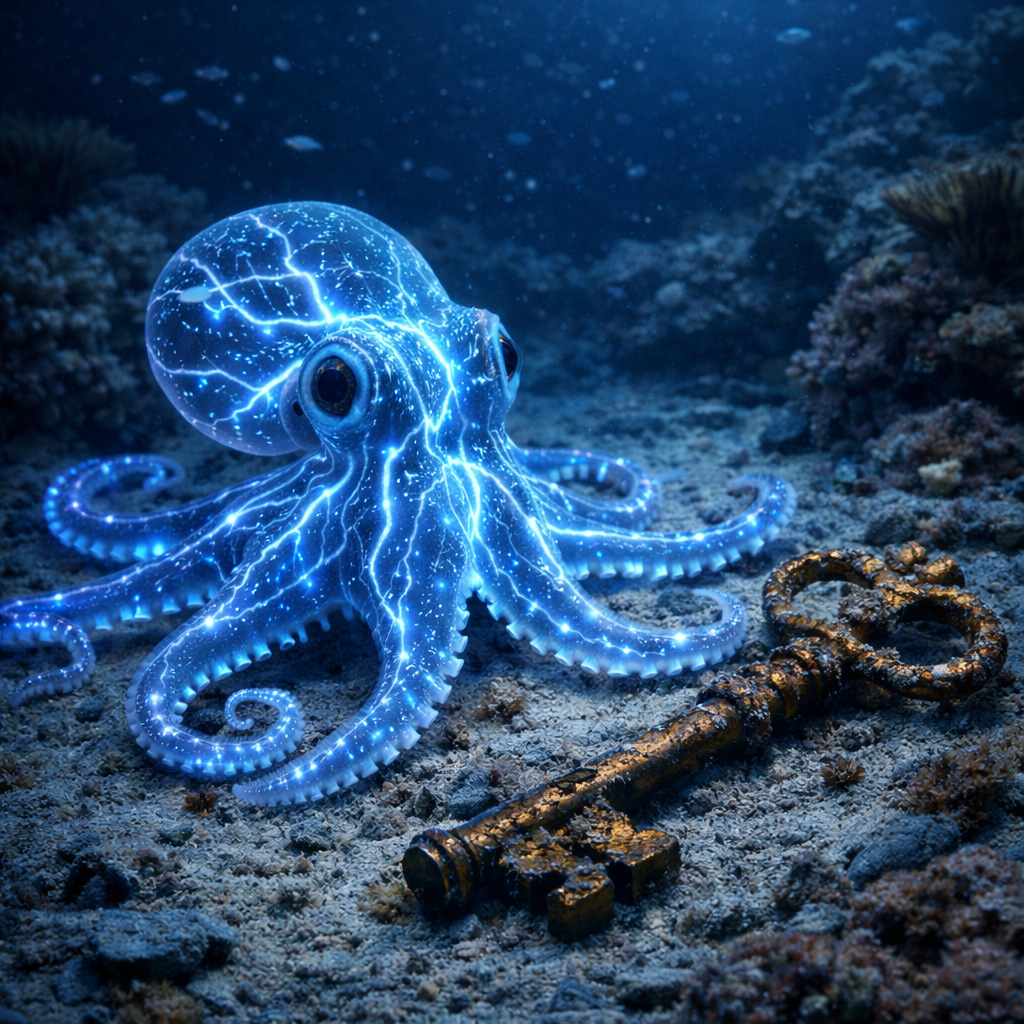
You assume your thoughts come from one place.
You assume your body waits for permission to act.
You assume perception looks roughly the same for anything with eyes.
There is a creature on this planet that quietly breaks all three.
Not one brain. Not nine minds. A network that works.
An octopus has ~500 million neurons—dog-level hardware.
The twist is the wiring.
- Central brain (between the eyes): learning, memory, integration
- Eight arm ganglia: dense neural hubs running each arm
- >50% of neurons live in the arms
Each arm can:
- taste and touch (suckers are chemo- + mechanosensors)
- explore and manipulate
- initiate movements locally
So control is not:
brain → command → body
It’s:
brain biases → arms act → feedback loops → behavior stabilizes
Multiple actions start in parallel. By the time you could point to a “decision,” parts of the body are already doing it.
One intelligence arriving from eight directions at once.
Fun, grounded details:
- Arms show loose specialization (front = more exploration; rear = locomotion/stability).
- There’s evidence for individual differences (bold vs shy, curious vs avoidant).
- A special arm in males—the hectocotylus—is used to transfer sperm.
The colorblind animal that disappears in full color


Most octopuses likely have a single photoreceptor type—which implies no conventional color vision like ours.
And yet they perform some of the most precise camouflage in nature:
- rapid shifts in color, contrast, and pattern
- 3D texture changes (papillae) from smooth to spiky
- seamless blending into coral, rock, sand
How?
They appear to solve camouflage without “seeing color” the way we do:
- Contrast & spatial pattern (edges, frequency, brightness)
- Polarization of light (orientation of light waves; useful underwater for revealing surfaces and materials)
- Optics trick (chromatic aberration): their unusual pupils may let them infer wavelength by how different colors blur at different focal settings
And the skin itself is a display:
- Chromatophores (expandable pigment sacs: yellows/reds/browns)
- Iridophores & leucophores (reflective layers for blues/whites/iridescence)

It doesn’t need to experience “blue.”
It needs to recreate the conditions under which a viewer fails to see it.
A body that might help itself see
Octopus skin contains opsins—light-sensitive proteins from the same family used in eyes. Light sensitive proteins ON THE SKIN.
What that likely means (with appropriate caution):
- The skin can respond to light directly (especially brightness/contrast)
- Camouflage is not only top-down (“brain tells skin”) but also locally tuned
Think less:
eye → brain → command → skin
More:
eye + skin + arms all contributing signals → continuous adjustment
Response can begin before there’s anything like a stable “self-image.”
Problem-solvers without a command center
They learn quickly and remember:
- unscrew jars from the inside
- navigate mazes
- discriminate shapes/patterns
- adjust strategies after failure
Key structures:
- Vertical lobe: major site for learning/memory (functionally analogous—not identical—to the mammalian hippocampus)
- Optic lobes: large, vision-heavy processing
There’s no big prefrontal “CEO.” Yet outcomes—flexible problem-solving, inhibition, switching strategies—still show up.
Same capabilities. Different architecture.
Not social… and still interactive


6
Octopuses are asocial:
- no group living
- no pair bonding
- minimal interaction with other octopuses outside mating
And still:
- they recognize individual humans (in lab/aquaria)
- show preferences (approach some, avoid others)
- sometimes squirt water at specific people
- engage in cooperative hunting with fish (e.g., groupers); if a partner “cheats,” the octopus may swat it
This isn’t language or shared symbols. It’s selective, learned engagement.
Interaction without a social identity scaffold.
Life cycle: intense, brief, all-in
- Hatch as tiny planktonic larvae → settle to the seafloor
- Live mostly alone
- Mate once (typical pattern)
- Female lays thousands of eggs, guards and aerates them, stops eating
- After hatching → female dies; males die soon after mating
This is semelparity: one massive reproductive investment, then shutdown.
(Controlled in part by the optic gland—remove it experimentally and lifespan/behavior change.)
A short life, no teaching, no culture—yet robust learning within a single lifetime.
What this says about “how minds work”
You came for octopus facts—keep them. They’re the point.
But notice what they quietly imply.
- Control can be distributed without chaos
- Perception can differ radically and still solve the same problems
- Action can begin before a single, narrated “decision”
- Interaction can occur without social identity
If the human mind feels like a spotlight—one beam, one voice—
the octopus is a lantern: many inputs, many outputs, continuously integrated.
Keepable takeaways
- ~500M neurons, majority in arms
- Central brain + 8 arm ganglia → parallel processing
- Likely colorblind (single photoreceptor)
- Camouflage via chromatophores + reflective cells + texture
- Uses contrast, polarization, and optics to match environments
- Skin has opsins → local light responsiveness
- Strong learning/memory (vertical lobe) without a big prefrontal cortex
- Asocial, yet shows selective, learned interactions
- Semelparous life cycle: one reproduction, then death
The octopus doesn’t prove we’re wrong about minds.
It proves we were looking at only one way a mind can work.
Sometimes this spiritual, philosophical, psychological, internal work is really hard. All the lessons, all the pauses, all the exploring, and then to process and integrate it all. So my hero today is the octopus. An Integration Queen. Let us all be so inspired.
If this post resonates with you, consider subscribing for notifications of new posts.


Leave a Reply