
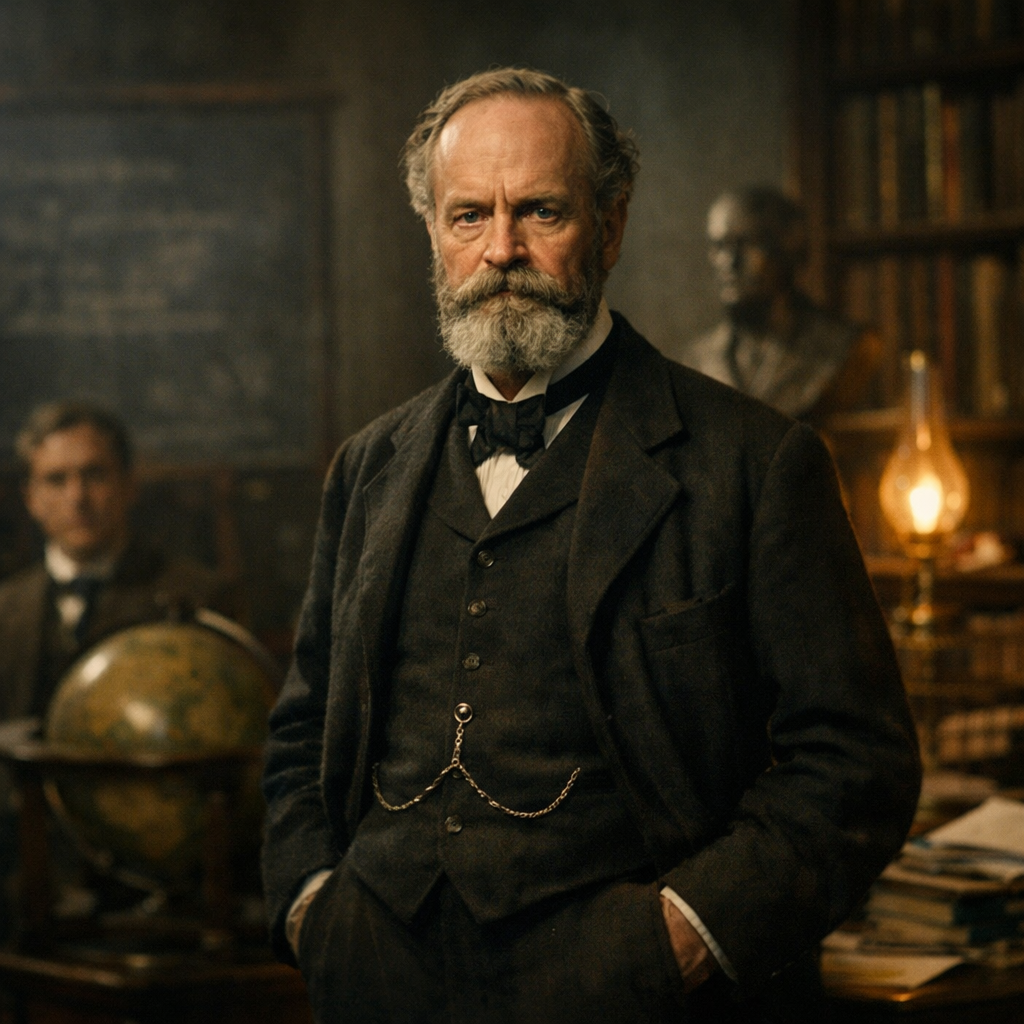
William James — The Mind as a Doorway, Not a Generator
There’s a particular kind of intelligence that doesn’t just try to find answers but also realizes more questions to ask and unconventional ways to further understanding.
That’s William James.

Not the kind of thinker who needed to win an argument. The kind who was willing to sit inside a question long enough for it to become something else entirely.
He is often introduced as the “father of American psychology,” which is true… but incomplete. What he really did was even more interesting because it was kind of dangerous at the time:
He took inner experience seriously at a time when the world was beginning to dismiss anything it couldn’t measure.
And instead of trying to prove or disprove the existence of God, he asked something far more useful:
What actually happens to a human being when they believe they’ve encountered something beyond themselves?

The Life That Made the Question Inevitable
William James was born in 1842 into a family that did not do small thinking.

His father was a theologian. His brother, Henry James, became one of the greatest novelists in history. Their home was intellectually alive—philosophy, religion, art, science… all in constant conversation.
And yet, for all of that exposure to a range of brilliance, William James struggled. Deeply.
Not just mood swings or bouts of melancholia. He experienced periods of depression so intense they bordered on paralysis. Not just sadness. Existential destabilization. The kind where you question whether you have agency at all. Whether your thoughts are yours. Whether anything is.
There’s a moment in his journals where he describes being overtaken by a sudden, visceral fear of losing control of his mind. It wasn’t abstract. It was embodied and immediate. Terrifying when you really think about what that must have been like.
From The Varieties of Religious Experience (where he recounts his own earlier experience):
“I remember the horror of it… as if something hitherto solid within my breast gave way entirely, and I became a mass of quivering fear.”
Not just fear of losing control—
but recognition that the boundary between “me” and the “hitherto solid within” might not be stable. Which is… honestly one of the most disorienting human experiences available.
This set up matters to understand his dedication for his later life research.
Because James didn’t study consciousness from a distance. He studied it also from the inside.
At one point, unable to prove free will existed he did something different… he made a decision that would shape everything that followed:
He chose to believe in it anyway.
His turning point was on April 30, 1870:
From the journal of William James:
“I think that yesterday was a crisis in my life.”
He names it outright.
Not a mood. Not a phase. A crisis.
And then. He opens.
“My first act of free will shall be to believe in free will.”
Not because it was logically airtight—but because the belief itself changed how he lived.
That’s the first glimpse of what would become his defining philosophy:
Truth is not just what can be proven.
Truth is what transforms.
This wasn’t:
“I read something interesting and changed my mind.”
This was:
- He had been stuck in determinism (everything is caused, nothing is chosen)
- Which led to paralysis
- Which fed his depression and instability
He realized something crucial:
If determinism is true, I can’t choose anyway. If it’s false, I must choose.
So he does something radically practical: He treats belief itself as an experiment. The best test of a spiritual concept and the most overlooked: Does it work? What fruits will this mindset bear? Not: “Is this provably true?” But: “What happens if I live as if this is true?”
This approach is as delightful as it is refreshing. Because he’s not saying, “I figured it out.” He’s saying, “I can’t solve this. So I’m going to step into something and See. What. Happens.”
That’s the move. Not certainty. Not proof. A decision.
And here’s where it gets even better, because he doesn’t walk this back later. He builds on it. Years later, he writes:
“Faith is a readiness to act in a cause the prosperous issue of which is not certified to us in advance.”
That’s not religion. That’s not blind belief. That’s Humility.
I don’t know how this ends.
I don’t know if I’m right.
I’m moving anyway.
And that is such a different energy than waiting to be sure before you act.
Then you start to see how his world shifts—not in some dramatic overnight enlightenment way, but in how he relates to reality.
He writes:
“The greatest discovery of my generation is that a human being can alter his life by altering his attitudes.”
And if you read that quickly, it sounds like something you’d scroll past on a quote graphic.
But coming from him?
That’s a man who watched his own mind nearly collapse in on itself…
choose a stance…
and then experience what changed because of that stance.
Not because he proved anything.
Because he participated differently.
“Change the way you look at things and the things you look at change.”
― Wayne W. Dyer
The Scientist Who Refused to Flatten the Human Experience
James helped establish psychology as a scientific discipline at Harvard. He built labs. He taught courses. He wrote foundational texts. Kind of a big deal, this guy. But he resisted something that many of his peers leaned into: Reducing the human mind to machinery.
He introduced the idea of the “stream of consciousness”—that thought is not a series of separate units, but a continuous flow. Always moving. Always shaping itself.

He emphasized attention as a force:
What you attend to doesn’t just reflect reality.
It selects it.
The Stream, and What It Changed
William James didn’t set out to sound poetic; he was really trying to be precise. And what he noticed, simply by paying attention, was that the mind does not behave the way people were describing it. It doesn’t come in clean, separate units. It doesn’t pause politely between thoughts.
It moves. Continuously.
Subtly shifting, blending, carrying traces of what just was into what comes next. So he stopped talking about “ideas” as if they were objects and started describing consciousness the way it actually feels from the inside: not as pieces, but as a stream—a flow that is personal, continuous, and always in transition.
That shift matters more than it sounds like it should. Because the moment you stop thinking of your mind as something made of fixed parts, you stop expecting it to behave like something stable. You stop waiting for the “right” thought to land and stay. You start to see that identity itself isn’t a solid thing you locate—it’s something that forms in motion. Each thought isn’t isolated; it carries context, tone, memory, and direction. It leans into the next one. It’s less like building blocks and more like current.
And then James adds one more layer that quietly changes everything: attention. You don’t control the stream in any absolute way, but you are not irrelevant to it either.
What you repeatedly attend to begins to shape the pattern of flow. Not instantly and not perfectly, but over time, in a way that is undeniable once you see it. Which means you are not a passive observer of your mind, but you’re also not its absolute authority. You’re something in between—a participant inside a moving system (a paradox I can get behind).
The implication is both unsettling and relieving. Unsettling, because there’s no fixed place to stand and declare, “this is me, permanently.” But relieving, because it means you are not trapped inside any single thought, mood, or identity either.
If consciousness flows, then what feels stuck is often just something being revisited, reinforced, or held in place by attention. And if attention can shift—even slightly—then the direction of the whole system can begin to shift with it.
James didn’t turn the mind into something mystical. He just described it honestly enough that it stopped looking mechanical. And once you see that, you stop trying to force stillness where there was never supposed to be any. You stop treating thoughts like facts carved in stone. And you start to understand yourself less as something to define—and more as something unfolding.
And quietly, underneath all of this, he was circling something bigger:
What if the mind is not the origin point?
What if it’s something else entirely?

The Filter, Not the Source
This is where William James quietly steps out past even modern psychology and into something that still feels… into the realm of the mystical.
Because if the “stream” reframed how the mind moves this reframes what the mind is.
James started noticing something that didn’t quite fit the dominant view:
If the brain produces consciousness…
why does so much of our experience feel limited rather than generated?
Why do we forget more than we remember?
Why does attention narrow instead of expand?
Why do certain states—trauma, fatigue, illness—feel like constriction, not loss of production?
So instead of asking, “how does the brain create consciousness?”
he entertained a different possibility:
What if the brain is not producing consciousness… but filtering it? Brain. Exploding.

From The Varieties of Religious Experience:
“The brain is an organ for limiting consciousness.”
Not creating.
Not generating.
Limiting.
That one word changes the whole paradigm.
What he’s actually suggesting
James isn’t saying, “here’s the answer.”
He’s saying:
What if consciousness is larger than the individual mind…
…and what we experience as “me” is just a narrowed channel of it?
He describes ordinary waking awareness as:
“but one special type of consciousness, whilst all about it, parted from it by the filmiest of screens, there lie potential forms of consciousness entirely different.”
Read that again slowly. F-i–l–m–i–est… (j/k, the other part, lol.)
Not:
“there might be more if we imagine it.”
But it’s already there. Just outside the range we’re tuned to. (Wait. What?!) (Are you seriously telling me that the “Kingdom of Heaven” might literally be at hand, but I just can’t see it? But could I if I learn how to adjust my filter?)
✧ Why the filter idea makes sense (in his framework)
If the brain is a filter, then its job is not to expand awareness.
Its job is to select, reduce, and organize.
So that you can function as a human being. A mammal running around this mad, dangerous world.
Otherwise? You’d be flooded. No boundaries. No focus. No survival.
So what we call “normal consciousness” might actually be definitely a useful narrowing, but not the full picture.
✧ The implications (this is where it gets interesting)
If this is even partially true…
Then moments where the filter shifts… not breaks, not disappears, but loosens… start to make a different kind of sense.
Things like:
- mystical experiences
- deep meditation
- altered states
- creative flow
- even certain psychological breaks
Instead of being dismissed as noise or dysfunction, they become variations in the filter.
(Brain. Still. Exploding.)
✧ He never forces a conclusion (and that’s the point)
James does not say: “This proves anything.”
He leaves it open. (My kind of theologian.)
But he refuses to collapse experience into something smaller just because it’s easier to explain.
He holds the possibility that what we experience as reality may be a partial bandwidth.
✧ The quiet shift in perspective
Once you consider this perspective, a few things are shown in a different light. You stop assuming your current perception is the full picture. You become a little more curious about states that don’t fit your usual framework. And maybe most importantly: you stop identifying so tightly with the narrow slice you happen to be experiencing right now.
And, again, James never asks you to believe that outright.
He just places it on the table and says:
Look at your experience.
…and decide what fits.
The Varieties of Religious Experience — What He Actually Did and Why it Was Groundbreaking
Published in 1902, The Varieties of Religious Experience is not a book about religion in the institutional sense.
It’s a study of direct experience.
James collected first-person accounts from people who described:
- sudden conversions
- mystical union
- profound peace in the face of death
- overwhelming love
- complete identity shifts
He didn’t filter them through doctrine. He didn’t dismiss them as pathology. He didn’t automatically validate them either.
He did something far more precise: He observed.
And then he asked:
What are the common features of these experiences?
And what do they do to the people who have them?
His Most Important Observations (without the fluff)
James noticed that genuinely transformative experiences tend to share a few characteristics:
They feel immediate — not secondhand, not learned, not inherited.
They feel authoritative — not in a controlling way, but in a way that reorganizes certainty from the inside.
They are often ineffable — people struggle to put them into words without reducing them.
And they are typically temporary — but their effects are lasting.
But here’s where he becomes really interesting and I love the humility here. He did not say, “Therefore, these experiences prove God exists.”
He said, “Regardless of origin, these experiences consistently lead to meaningful psychological transformation.”
People become less afraid, more compassionate, less rigid, and more grounded in something deeper than surface identity.
So instead of debating their metaphysical validity, he evaluated their functional impact.
The Perspective Shift
James introduced what he called pragmatism.
Not in the watered-down, practical sense—but in a very specific philosophical way:
The “truth” of an idea can be evaluated by its effects in lived experience.
If a belief system produces coherence, stability, compassion, and clarity… it holds a kind of truth, regardless of whether it can be empirically proven.
This doesn’t mean “anything goes.” It means that experience matters, outcomes matter, lived reality matters. And then he goes one step further.
The Quietly Radical Idea About Consciousness
James suggested that consciousness might not be produced by the brain.
He used an analogy:
The brain may function more like a filter or receiver—limiting a broader field of awareness so we can function in physical reality.
Not creating consciousness…
But narrowing it.
Which opens a question that he never fully answered (and didn’t try to):
What exists beyond the filter?
He left that open on purpose.
Why He Still Feels Modern
James gives you permission to do something that still feels oddly rebellious:
To take your inner experience seriously without abandoning discernment.
You don’t have to collapse everything into biology, blindly accept every feeling as truth, or choose between science and spirituality.
You can hold tension.
You can explore.
You can test what actually changes your life.
And this is where his work quietly aligns with what many people discover on their own:
The most meaningful shifts don’t come from being told what is true.
They come from encountering something that feels true—and then watching, experiencing, what it does to you.
Embracing the mystery as well as the logic.
How He Became so Revered
Not because he had answers.
Because he didn’t run from the questions.
Because he experienced instability and didn’t numb it out with certainty.
Because he allowed both scientific observation and mystery to coexist without forcing resolution.
Because he paid attention.
That’s it.
Death and What He Left Behind
William James died in 1910.
He didn’t leave behind a system to follow.
He left behind a way of looking:
- Start with experience
- Observe honestly
- Stay intellectually rigorous
- Don’t dismiss what you don’t yet understand
- Let outcomes inform belief (not belief inform outcome, be openminded to what unfolds- I Love That!)
He didn’t close the loop.
He widened it.
The Takeaways That Actually Matter
Not the kind you skim. The kind you sit with.
You don’t need full certainty to move forward.
You need something that holds up in lived experience.
Not everything real can be measured.
But what is real leaves a trace—in behavior, in perception, in how you move through the world.
Your attention is not passive.
It is shaping what becomes real for you.
And maybe the most unsettling one:
What you think of as “you” might be less fixed than you assume.
More like a channel than a source.
If You Want to Go There
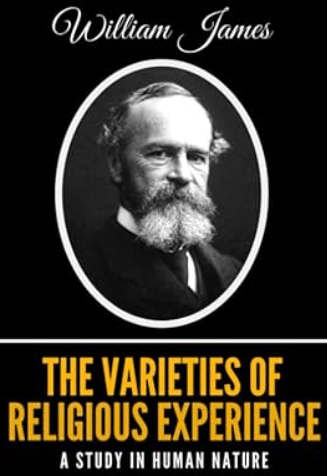
Read The Varieties of Religious Experience slowly.
Not as a historical text.
As a mirror.
Watch what you dismiss.
Watch what resonates.
Watch what makes you uncomfortable.
That reaction might be more informative than the content itself.
(Fair warning… it’s a pretty thick read. But worth it. If you have the energy and patience.)
*** If you like to read cool articles about cool people but stop at the affiliate marketing shopping part: Thanks so much for reading! Subscribe for new releases! If you like to shop the vibe afterwards… read on!
Shop the Vibe (if you feel like it)
A solid, slightly worn hardcover book you actually read with a pencil in hand

From the man, himself…
If this resonated, consider subscribing. We’ll be here.


Leave a Reply