
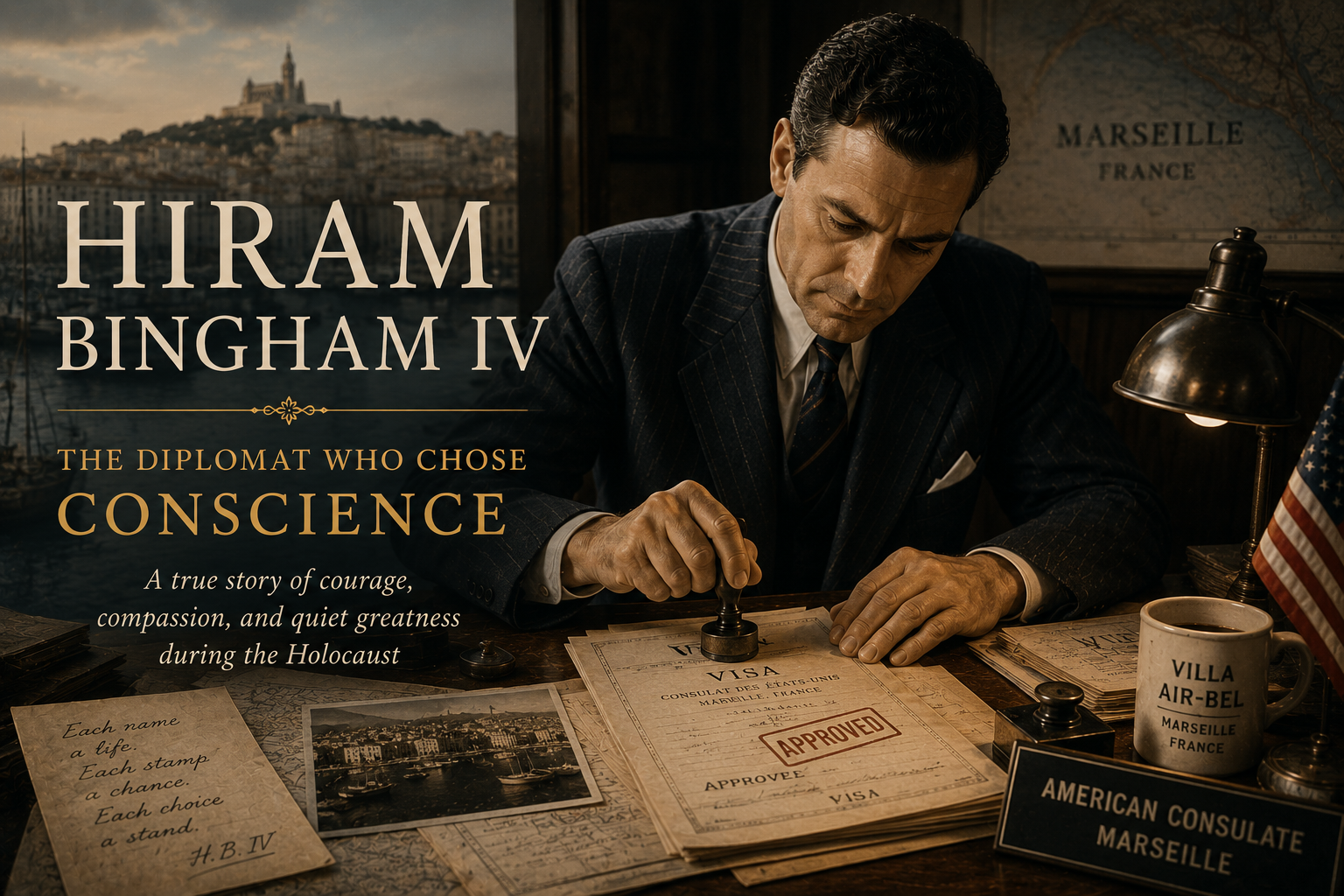
Hiram Bingham IV had every reason to keep his head down.
He came from privilege. Groton. Yale. Harvard Law.
His father had become world-famous for bringing Machu Picchu to international attention before serving as governor and U.S. senator. His mother came from the Tiffany family. Everything about Harry’s life pointed toward prestige. His future was already mapped.
His job wasn’t to decide who deserved saving.

In 1940, Bingham was serving as the American vice consul in Marseille after France fell to Nazi Germany. The city became one of Europe’s last escape routes. Thousands of refugees—many of them Jewish—desperately sought American visas before the Vichy government and the Nazis closed the door behind them. Washington D.C. had other priorities.
Applications stalled beneath investigations, delays, and technicalities. On paper, these were procedures. In practice, they often became death sentences.
Harry Bingham began doing something dangerous.
He didn’t break the rules.

Where others saw reasons to delay, he saw reasons to act. Where others found technicalities, he found humanity. He interpreted the law as generously as he believed it allowed—and perhaps as generously as it demanded. He expedited paperwork. He issued visas.
He quietly worked with Varian Fry’s underground rescue network, helping artists, writers, scientists, and ordinary families escape occupied Europe.

Among those who reached safety were Marc Chagall, Hannah Arendt, Max Ernst, and Lion Feuchtwanger. When Feuchtwanger escaped an internment camp, Harry and his wife, Rose, hid him in their own home while arrangements were made for his escape. That wasn’t simply paperwork anymore.
That was conscience.

This is the heart of the story that fascinates me.
Everyone notices courage. Almost nobody notices humility. The bureaucracy wasn’t made entirely of monsters. Many people believed they were protecting procedure. Protecting order. Protecting their careers.
Harry asked a different question.
Not, “Am I allowed?”
But….

Humility isn’t thinking less of yourself.
It’s refusing to let the role you’ve assumed become more important than another person’s life.
His reward?
His diplomatic career stalled. He was transferred. The ambassadorship he had worked toward never came. Later, after reporting Nazi activity in Argentina, many of his warnings were again ignored. He eventually left the Foreign Service. He spent the rest of his life raising eleven children on a Connecticut farm. He painted. He played the cello.
He rarely spoke publicly about Marseille. After his death, hidden documents revealed what he had quietly done.
Historians now estimate he helped more than two thousand—and perhaps as many as twenty-five hundred—refugees escape Nazi-controlled Europe.

There is one fascinating wrinkle.
Yad Vashem chose not to name Harry Bingham one of the “Righteous Among the Nations.”
He had massive courage.
He expressed brave compassion.
But because they concluded he generally acted within the legal authority of his diplomatic office, even while exercising that authority with unusual humanity.
That raises a question worth asking.

Perhaps the answer is simpler than we imagine. Every generation imagines that its greatest moral tests arrive wearing uniforms. More often they arrive carrying clipboards. They ask us to process… to delay… to follow procedure… to avoid making exceptions.
History rarely remembers the forms. It remembers the people who refused to forget the human being standing on the other side of the desk.
Amy Dinaburg, Philosopher, Retired ER RN, MS (Molecular Biology)


Leave a Reply