
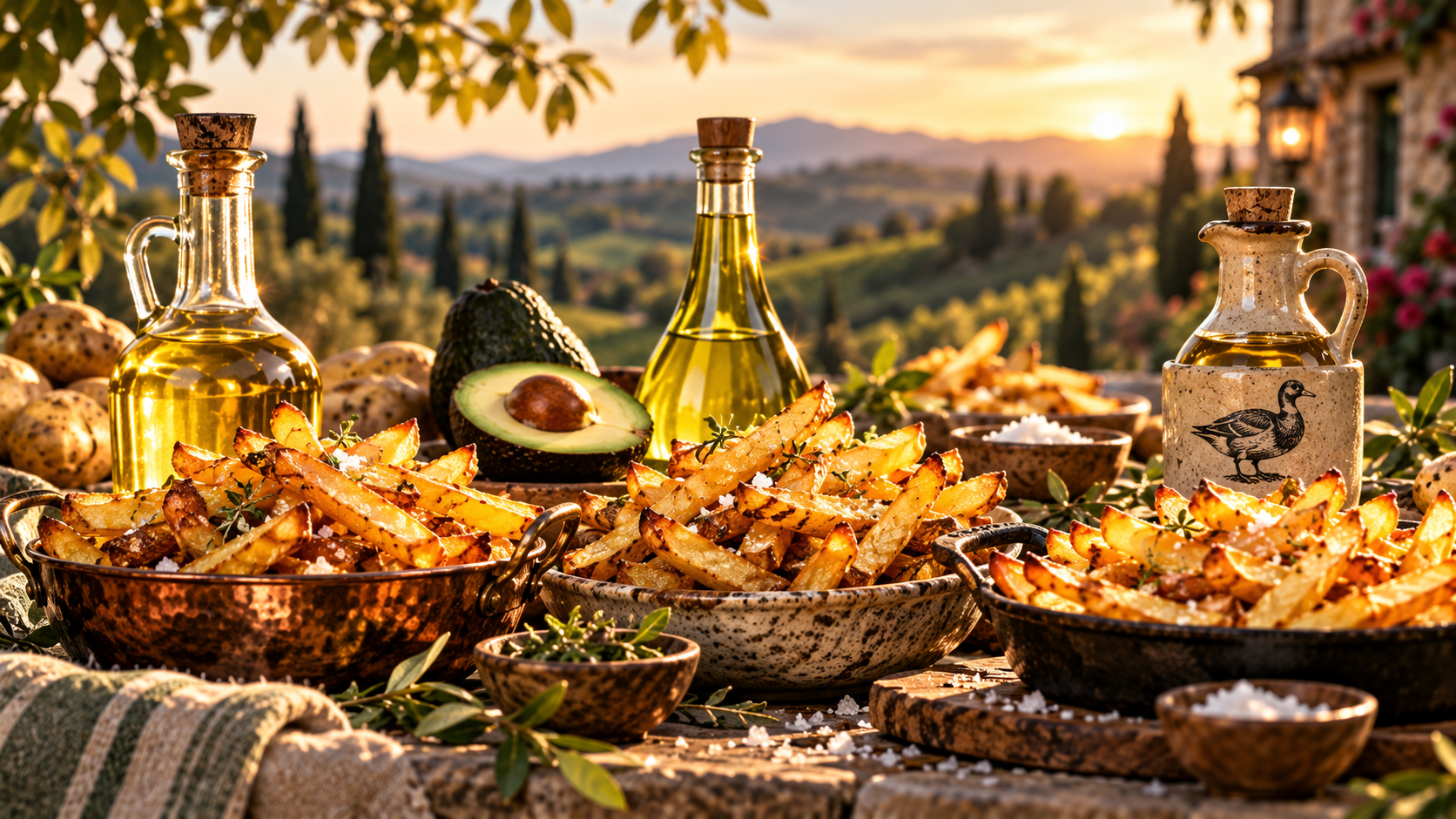
My husband heard that seed oils are bad. I had also heard that seed oils are bad.
Specifically, I had heard enough things about omega-6 fatty acids and inflammation and oxidation and industrial processing to have filed the entire subject somewhere in the back of my brain under Things I Should Probably Look Into Someday.
Then Josh mentioned it. Ugh. Because now I have to know. And I want them to have character names, so I remember them when I go down the grocery aisle.
Not in the abstract, either. I don’t particularly care which cooking oil wins an imaginary biochemical purity contest. I want to know something much more useful:
I have a potato. I would like to turn it into a French fry. What the hell should I fry it in? (When the air-fryer is voted Down.)
Canola?
Peanut?
Olive oil?
Avocado oil?
Beef tallow?
Lard?
Butter?
That enormous bottle labeled VEGETABLE OIL, which is somehow permitted to conceal its botanical identity like it’s in witness protection?
Oh, and what about Duck Fat. I heard that’s the Holy Grail of Frying… Mediums (is that the right word?).
And what exactly are we trying to accomplish here?
Because obviously I want the fry to taste good. I want it crispy on the outside and fluffy on the inside. I would prefer not to spend $34 filling a pot with artisanal avocado oil unless artisanal avocado oil is going to personally change my life.
But I would also like to know what happens to that oil when I heat it to around 350–375°F. And I don’t have a thermometer on my stove for frying potatoes. It gets hot, I fry the things, and then I turn off the stove.
And what happens to me after I eat it.
Those turn out not to be the same question.
Welcome to The Great French Fry Oil Audition.
The rules are simple. You have one potato. You have one job.
Fry it.
First, We Need to Talk About What Frying Actually Does (for the nerds in the front… me.)
Deep frying looks extremely simple.
Put food in hot oil.
Wait.
Remove delicious food.
Chemically, however, we have created a tiny screaming hellscape. The moment our potato hits the oil, water inside the potato starts moving outward. At the surface, that water meets oil somewhere around 350–375°F and rapidly turns to steam. Bubbles explode around the potato. The exterior dries out. Starches change. Browning reactions get underway. The crust begins becoming the magnificent crispy shell for which we agreed to undertake this entire investigation.
Meanwhile, the oil is having a day. It is hot. It is exposed to oxygen. It is encountering water.
And if we’re reusing it, we’re doing all of this to the same oil again and again.
That matters because cooking fats aren’t just anonymous slippery yellow liquids. They’re mixtures of different kinds of fat molecules, and those molecules do not all respond to this environment in the same way.
I promise I am not going to make you memorize them. But I am going to show you one picture.

The important part is ridiculously simple: Some fats have more chemically vulnerable spots than others.
Those little bends and double bonds you see in diagrams of unsaturated fatty acids aren’t just decorative molecular elbows. They affect how readily the fat can react with oxygen, particularly when we start heating it.
Generally, more unsaturation means more opportunities for oxidation. This is bad. Oxidation means the bonds are breaking.
And this is where the internet took one perfectly legitimate piece of chemistry, put it in a tiny car, drove it directly through a guardrail, and arrived at: Seed Oils Are Poison. Wellll..
Maybe. Maybe not.
We’re going to need considerably more evidence than that.
So let’s meet the oils.
Contestant One: Canola the Controversial

Canola Oil has requested legal representation.
This seems reasonable, because according to the internet she has personally caused obesity, inflammation, heart disease, cancer, metabolic dysfunction, the collapse of Western civilization and possibly your divorce.
Those are serious charges. And Canola would like to remind the court that she came here to fry a potato.
So before we convict her, let’s find out what is actually in the bottle.

And that is really the whole Canola situation.
She’s mostly monounsaturated fat. She’s relatively low in saturated fat. She has some omega-6 and omega-3 fatty acids. She’s cheap, neutral, easy to find, and perfectly capable of frying a potato.
She’s also not immortal. Heat changes oil. Oxygen changes oil. Time changes oil. And if you heat the same oil over and over again, those changes accumulate. This is important, because somewhere along the way the internet turned a perfectly reasonable chemistry question—
What happens to different oils when we heat them?
—into a much more dramatic one: ARE SEED OILS POISON?! Those are not the same question. Canola doesn’t need to be either a health food or Satan’s Crisco.
For ordinary home frying, she’s a remarkably practical oil.
If you’re running a French-fry stand and keeping the fryer going all day? Now I care a lot more about oxidative stability, and we’re going to meet some fats that are considerably harder to chemically mess with.
Which brings us to a contestant who has been waiting outside this entire time, leaning against a motorcycle and looking unbearably smug.
Beef Tallow

Beef Tallow: The Old-School Heavyweight
Oh, he’s been waiting for this.
Beef tallow is rendered beef fat. Before bottles of vegetable oil became ubiquitous, animal fats were perfectly ordinary residents of the frying pan—and tallow is very, very good at frying things.
This is where our experiment gets interesting.
Because if the only question were: Which fat would most enjoy spending an evening at 375°F with a potato?
Tallow would be extremely difficult to intimidate.
Why is tallow so good at frying?
Basically, he’s sturdy.
Tallow contains a lot more saturated fat than canola and a substantial amount of monounsaturated fat. That makes it relatively resistant to the chemical abuse we’ve been talking about.
Heat. Oxygen. Time.
Tallow still changes when you heat it. Every frying fat does. But compared with oils containing lots of more oxidation-prone polyunsaturated fats, tallow has fewer vulnerable places for oxygen to start causing trouble. Which means tallow tends to hold up remarkably well in a fryer.
And, unlike Canola, he does not arrive quietly. Tallow tastes like something. French fries cooked in beef tallow have a rich, savory flavor that became famous enough that people still wax nostalgic about them decades later.
Here’s the catch… (you knew it was coming…)
Unfortunately, we eventually have to eat the French fry.
And this is where frying chemistry and human nutrition refuse to give us one convenient answer.
Tallow’s higher saturated-fat content is part of what makes it so stable under heat. It’s also the reason I wouldn’t automatically crown it the healthiest oil in the competition.
When saturated fats replace unsaturated fats in the diet, LDL cholesterol generally goes in the wrong direction. When saturated fats are replaced with unsaturated fats—particularly polyunsaturated fats—LDL falls, and the broader cardiovascular evidence favors that substitution.

So we have our first really beautiful contradiction:
The thing that makes tallow harder to damage in the fryer is not necessarily the thing we want more of in our diet.
There is no betrayal here. The fryer and your arteries simply have different job descriptions.
THE FRENCH FRY REPORT
Can he take the heat? Oh, absolutely.
Good fries? Very. Rich, savory, unmistakably fried-food fries.
Can I reuse him? Better than many oils. His fatty-acid makeup gives him good oxidative stability, although repeated heating still causes degradation and eventually every frying fat needs to be retired.
Is beef tallow secretly a health food because our great-grandparents ate it? No.
Is it poison because it contains saturated fat? Also no.
It’s a cooking fat with some genuinely excellent frying properties and a nutritional tradeoff worth knowing about.
Would I fry French fries in it? Oh, hell yes.
Would I therefore replace every fat in my kitchen with beef tallow? Nope.
And now I want to know why this guy can sit in a screaming-hot fryer looking smug while Canola eventually starts getting chemically frazzled.
For the nerds in the back: Take his shirt off. We’re looking at the molecules.

Peanut Oil: The Stage-Manager

Darling, she was made for this. Peanut Oil did not arrive at the audition on a motorcycle. She arrived on a porch.
There are magnolias. Someone has brought fried chicken. There is probably a pitcher of sweet tea nearby. And Peanut Oil seems mildly confused that the rest of us have turned frying food into an existential crisis. Because she has been doing this rodeo forever.
So what is peanut oil?
Exactly what it sounds like: oil extracted from peanuts. And compositionally, Peanut lands somewhere very interesting in our lineup.
She’s mostly monounsaturated fat (one double bond), with a decent amount of polyunsaturated fat (several double bonds) and relatively little saturated fat (no double bonds). Those double bonds are some of the places where heat and oxygen can start chemically messing with a fat.
So Peanut isn’t wearing quite as much molecular armor as Beef Tallow. But she’s also not particularly delicate. A large portion of her fat is oleic acid—the same monounsaturated fatty acid that makes up a large portion of olive oil.
And that gives Peanut a rather lovely combination: Enough stability to fry extremely well without needing to be mostly saturated fat.
Well, hello there.
Can she actually fry the potato?
Oh, yes. Peanut oil has long been popular for frying for a reason.
It tolerates normal frying temperatures well. Refined peanut oil has a high smoke point. Its flavor is mild enough that the potato still tastes like a potato, although depending on the oil, there can be a subtle richness or nuttiness.
And it makes a damn good French fry. Crisp outside. Fluffy inside. No weird competing flavor. Peanut is not trying to become the meal.
She’s hosting.
Chemistry

Because we’ve learned enough chemistry now to know what question comes next. What happens to her molecules while she’s sitting in hot oil? Same thing that happens to everybody else’s.
Heat happens.
Oxygen happens.
Oxidation happens.
And with enough heat, enough time, and enough repeated use, Peanut Oil eventually starts accumulating degradation products.
She is stable. She is not immortal. That distinction is becoming something of a theme around here.
In studies where researchers repeatedly fried potatoes in different oils, peanut oil held up reasonably well—but it still deteriorated with prolonged use.
So if you’re making fries for dinner? Peanut is entirely comfortable.
If you’re running the county fair fryer from dawn until somebody wins the giant stuffed banana at 11 p.m.? Now we’re asking a different chemistry question.
And then Peanut has a cousin.
Because apparently this family wasn’t complicated enough. High-oleic peanut oil.
This is peanut oil made from peanut varieties whose fat contains even more oleic acid and less of the more oxidation-prone polyunsaturated fat. Which makes it even more resistant to oxidation. And THIS is why I am increasingly annoyed by the phrase “seed oil.” Because regular peanut oil and high-oleic peanut oil are both oils from the exact same kind of seed. Peanut.
Yet change the fatty-acid proportions inside the oil and you change how that oil behaves under heat. The plant part tells us where the oil came from. The molecules tell us what it does. That is a much more useful piece of information.
Okay. But what happens after we eat the French fry?
Here Peanut gets another advantage over our handsome friend Beef Tallow.
She’s relatively low in saturated fat and mostly unsaturated. And when unsaturated fats replace saturated fats in the diet, LDL cholesterol generally goes down. Remember: LDL itself isn’t a glob of fat traveling around looking for an artery to cork.
LDL particles carry cholesterol through your bloodstream. When LDL levels stay elevated over time, more particles have the opportunity to enter the artery wall, become trapped, and participate in the inflammatory process that produces atherosclerotic plaque.
So Peanut gives us something interesting: Pretty damn good behavior in the fryer AND a predominantly unsaturated fat profile after we eat her.
Now we’re getting somewhere. That doesn’t turn French fries into cardiology. They’re still French fries. But we’re comparing fats here, and the nutritional differences between those fats are real.
THE FRENCH FRY REPORT
Can she take the heat? Absolutely. Refined peanut oil is very well suited to normal frying temperatures.
Good fries? Excellent. Crisp, rich, and generally neutral enough to let the potato remain the star.
Can I reuse her? Yes. Peanut oil has good frying stability and can be reused if it’s handled properly. But repeated heating still degrades it, so strain out the potato bits, store it properly, and eventually let the poor woman retire.
Is she a seed oil? Yep.
Does that answer whether she’s good for frying? Not even remotely.
How’s the nutrition profile? Mostly unsaturated fat, much of it monounsaturated, and relatively little saturated fat.
Can I afford enough to fill a pot? Usually.
She’s generally more expensive than canola or generic vegetable oil, which matters when your recipe begins with the instruction: Pour several cups of this into a pot.
Would I buy her specifically for French fries? Oh, yes.
Peanut Oil has made this competition considerably more interesting. Because Canola showed us that a cheap seed oil isn’t automatically nutritional napalm. Tallow showed us that excellent heat stability doesn’t automatically mean nutritionally superior. And Peanut just walked onto the porch carrying a third possibility: What if an oil can be pretty damn good at both?
She isn’t perfect. Nobody here is. But she’s stable, mostly unsaturated, delicious, reusable, and extremely comfortable around a potato.
Darling. She was made for this.
Soybean Oil: The Woman Behind the Curtain

You’ve met her. You just may not know you’ve met her. Soybean Oil is one of America’s great background actors.
Restaurant food.
Packaged food.
Mayonnaise.
Dressings.
Fryers.
And that bottle at the grocery store labeled simply: VEGETABLE OIL. Turn it around. There’s a decent chance our girl Soybean is standing backstage.
Why does everybody use her?
She’s cheap. She’s neutral. She’s plentiful. She fries a great french fry. This is not mysterious.
But traditional soybean oil contains a relatively large proportion of polyunsaturated fatty acids. Remember what that means? More double bonds so more places for oxidation breakdown.
That doesn’t make Soybean toxic. It means prolonged high-temperature frying and repeated reuse can be harder on her than on more oleic-rich oils.
Enter another plot twist.
High-oleic soybean oil exists too. Once again: Same crop. Different fatty-acid profile. Different frying behavior.

At this point, “seed oil” is beginning to look less like a useful chemical category and more like saying: These foods came from plants. Thank you, detective.
THE FRENCH FRY REPORT
Can she fry the potato? Absolutely.
Flavor? Practically invisible.
Affordable? Extremely.
Repeated frying superstar? Standard soybean wouldn’t be my first pick if I planned to punish the same oil all weekend.
Poison? No.
Soybean is the contestant who reminds us that cheap and ubiquitous are not scientific insults. She’s not glamorous. She’s infrastructure.
Sunflower Oil: The Identical Twins Who Aren’t Identical

Sunflower walks into the competition twice.
This is going to be important.
On the left: Regular Sunflower Oil.
On the right: High-Oleic Sunflower Oil.
They look nearly identical on the shelf. Chemically? Not the same woman.
Regular Sunflower

Traditional sunflower oil tends to contain a lot of linoleic acid, a polyunsaturated omega-6 fatty acid. Polyunsaturated means multiple double bonds. Multiple double bonds mean more opportunities for oxidation during prolonged high-temperature cooking.
Can you fry in it? Of course.
Would I choose standard sunflower for endless repeated frying merely because the front of the bottle has a cheerful flower on it? No.
Flowers are not chemistry.
High-Oleic Sunflower
And then her twin steps forward.
Through selective breeding, high-oleic sunflower varieties produce oil containing dramatically more monounsaturated oleic acid. Same sunflower. Completely different frying résumé.
This is one reason high-oleic oils are attractive for commercial frying: you can get much better oxidative stability without relying on partially hydrogenated oils.
THE FRENCH FRY REPORT
Regular Sunflower: Perfectly capable. More vulnerable under prolonged frying.
High-Oleic Sunflower: Now you have my attention.
And if this entire article accomplishes only one thing, let it be this: READ PAST THE FLOWER.
The fatty-acid profile matters.
CONTESTANT SIX
Olive Oil: The Mediterranean Matriarch

Olive Oil has heard enough.
She would like everyone to stop saying she can’t take heat. This woman has been standing next to fire for several thousand years.
But her smoke point!
Yes. Smoke point matters.
No. Smoke point is not the entire story.
Olive oil—particularly extra-virgin olive oil—contains a lot of monounsaturated oleic acid. It also contains minor compounds, including antioxidant phenolics, that don’t appear on our simple saturated/monounsaturated/polyunsaturated diagram. Those can matter too.
And studies of actual frying have repeatedly shown that olive oils can perform surprisingly well.
Which makes Olive our contestant who kicks over another oversimplification: The oil with the highest smoke point does not automatically win the stability contest.
Smoke point tells us something useful.
It does not tell us everything happening chemically inside the oil.

But do I want my French fries tasting like olive oil?
Ah.
Now we have a legitimate argument.
Depending on the olive oil, that flavor can range from mild to: HELLO. I AM AN OLIVE.
For some potatoes? Wonderful.
For the classic neutral French fry in your head? Maybe not.
And extra-virgin olive oil can be expensive when your cooking technique requires enough liquid to submerge Idaho.
THE FRENCH FRY REPORT
Can she take frying heat? Yes.
Seriously? Yes.
But the internet said— I know.
Nutrition profile? Excellent reputation for a reason: predominantly monounsaturated fat, with a substantial body of human dietary evidence behind olive-oil-rich eating patterns.
Flavor? Depends enormously on the oil and what you want.
Price? There she gets difficult.
Would I fry potatoes in olive oil? Absolutely.
Would I pour half a beautiful bottle of expensive peppery extra-virgin olive oil into a Dutch oven every Tuesday?
Madam, I have children.
CONTESTANT SEVEN
Avocado Oil: The Rich Girl

Avocado arrived late. Pilates ran long. She brought her own water bottle. And she would like you to know that her smoke point is extremely high.
We know, Avocado.
You’ve mentioned it.
On paper, she looks fantastic.
Avocado oil is generally rich in monounsaturated oleic acid. Refined avocado oil can tolerate high cooking temperatures. Its flavor is usually mild. Its fatty-acid profile looks quite attractive.
This should be easy. And then we arrive at the grocery-store shelf. $18.99.
Ma’am. We are frying a potato.
There’s another wrinkle.
With specialty oils, what the label says and what is actually in the bottle becomes unusually important. Quality, refinement, age, storage and authenticity can all affect what you’re actually cooking with.
So while a good avocado oil can be an excellent high-heat cooking oil, buying it simply because AVOCADO = HEALTH and HIGH SMOKE POINT = BEST is not sufficient analysis.

THE FRENCH FRY REPORT
Can she take the heat? Very well.
Fatty-acid profile? Lovely.
Flavor? Generally mild, especially refined.
Nutrition? Predominantly unsaturated.
Can I afford to fill the fryer with her? That depends.
Are you Avocado? Avocado Oil is an excellent contestant. She is also why Affordability gets its own category on the card.
CONTESTANT EIGHT
Lard: Your Grandmother’s Grandmother

Lard did not ask to become controversial. She was busy making pie crust.
Lard is rendered pork fat, and despite being commonly shoved into the mental category of SATURATED ANIMAL FAT, she’s actually a mixture. She contains substantial monounsaturated fat along with saturated fat and some polyunsaturated fat.
Which means she’s generally quite capable around heat. And she brings flavor. Depending on how the lard was rendered and processed, that flavor can be subtle or distinctly porky.
Lard versus Tallow
These two are cousins, not twins. Their fatty-acid profiles differ. Their flavors differ. Their physical properties differ.

And both remind us that “animal fat” is no more chemically precise than “seed oil.”
Nutrition?
Same basic complication we met with Tallow. Lard contains more saturated fat than most of our liquid plant oils. That gives it some useful physical and cooking properties.
But if we’re thinking about habitual dietary patterns and LDL, current cardiovascular guidance favors replacing sources of saturated fat with unsaturated fats. That doesn’t mean Grandma’s biscuits killed anybody.
It means frequency, amount, substitution and overall diet matter.
THE FRENCH FRY REPORT
Can she fry? Absolutely.
Flavor? Potentially glorious.
Heat stability? Good.
Nutrition? Mixed-fat profile, but more saturated fat than our unsaturated plant-oil contestants.
Would I use her? For the right potato? Grandma, hand me the apron.
CONTESTANT NINE
Ghee: The Golden Alchemist

Butter wanted to compete. Her publicist begged her not to.
Because regular butter contains something our pure oils don’t: water and milk solids.
Put whole butter over serious frying heat and those milk solids can brown and eventually burn. Delicious at the right temperature. Not ideal for deep frying. But then Butter disappears backstage.
There is a flash of gold.
And she returns as: GHEE.
What happened?
Clarifying butter removes most of the water and milk solids, leaving primarily butterfat. Suddenly our fragile dairy princess has considerably better heat tolerance.
Same origin. Different cooking behavior. Chemistry strikes again.
And the nutrition?
Removing the milk solids doesn’t magically remove the saturated fat. Ghee remains rich in saturated fat.
So once again: Excellent cooking performance does not automatically equal nutritional superiority.
But as a cooking fat? Oh, she’s magnificent. Rich. Buttery. Nutty. Golden.
French fries cooked in ghee are not pretending to be restrained.

THE FRENCH FRY REPORT
Heat? Very good.
Flavor? Big.
Nutrition? Saturated-fat-heavy.
Price? Not Canola.
Would I fry potatoes in it? Yes.
Would I use several cups every time my children ask for fries? Please see previous statement regarding children.
CONTESTANT TEN
Butter: The Beautiful Disaster

Butter would like a word. No.
Sit down. I love you.
You are not winning this.
Butter is approximately 80% fat, with the remainder mostly water plus milk solids. And those non-fat components are precisely why ordinary butter is not our ideal deep-frying medium.
At high enough temperatures, the milk solids brown. Then burn.
Which is gorgeous when we’re making brown butter. Less gorgeous when we’re trying to maintain a pot of frying fat.
THE FRENCH FRY REPORT
Flavor? Five thousand stars.
Deep-frying practicality? Girl.
Can I cook potatoes in butter? Please do.
Should I fill a deep fryer with ordinary butter? There are easier ways to experience disappointment.
Butter exits the competition furious but remains invited to dinner.
CONTESTANT ELEVEN
Coconut Oil: The Wellness Influencer

Coconut Oil has 2.7 million followers. She would like to talk to you about toxins. She has excellent lighting.
And chemically, Coconut is fascinating. Coconut oil is extraordinarily high in saturated fat. Which means—remember our fryer chemistry?—she is relatively resistant to oxidation. From a pure heat-stability standpoint, Coconut has some impressive armor.
And this is where the word healthy becomes spectacularly unhelpful.
Because what does “healthy” mean?
Stable in a fryer?
Raises LDL less?
Contains certain micronutrients?
Associated with better long-term outcomes?
Has a leaf on the label?
These are different questions.

Coconut oil’s high saturated-fat content helps make it oxidation-resistant.
That same saturated-fat content is why cardiovascular guidance does not place coconut oil in the same category as predominantly unsaturated oils like olive, canola or peanut.
Again: The fryer and your arteries have different job descriptions.
And then there’s taste.
Depending on whether it’s refined or virgin, Coconut may either behave fairly quietly or make your French fry wonder whether it has accidentally become dessert.
THE FRENCH FRY REPORT
Stable? Yes.
Mostly saturated? Very.
Automatically healthier because it came from a coconut? No.
Automatically poison? Also no.
Coconut has taught us perhaps the most important lesson of the entire competition: “Natural” is not a fatty-acid profile.
SIDEBAR
Bacon Grease: The Ancestor Jar

Bacon Grease was not formally invited. She came anyway. Because of course she did.
I keep mine in a mug. You may have a jar. Your grandmother may have possessed a vessel that had been receiving bacon grease continuously since the Eisenhower administration. We need to discuss this.
Bacon drippings are not exactly the same thing as clean rendered lard. They can contain salt, browned food particles, water and compounds from the bacon itself. That does not mean you can’t cook with them. You absolutely can.
But if you’re saving bacon grease:
Strain it while liquid.
Put it into a clean container.
Cover it.
Refrigerate it.
And perhaps do not pour today’s hot bacon grease onto a geological core sample of every breakfast your family has eaten since 1987.
If it smells rancid or otherwise wrong: The ancestors release you. Throw it out.
Also, unless you are cooking bacon on an industrial scale, you probably don’t have enough of it to deep-fry French fries. But fried potatoes in a spoonful of bacon grease? We are not monsters. Proceed.
CRISCO: THE ENGINEER

Crisco has entered the competition carrying blueprints. Everyone else showed up as some version of a thing that existed first—a peanut, an olive, a cow, an avocado.
Crisco showed up with specifications. What do you need the fat to do?
Stay solid at room temperature?
Keep for a long time?
Make flaky pie crust?
Survive heat?
Behave predictably?
Fine.
Give him a minute.
This is where our French fry competition gets historically interesting, because Crisco is not simply another oil. Shortening is a designed fat. And for much of the twentieth century, one of the technologies used to design fats like shortening was partial hydrogenation.
And partial hydrogenation gave us one of food chemistry’s more spectacular: Well. Shit.
The Trans-Fat Problem
Vegetable oils contain lots of unsaturated fatty acids. Unsaturated means there are carbon-carbon double bonds in their fatty-acid chains.
Food chemists learned that adding hydrogen could change those oils—making them more solid, more stable, and useful in products where liquid oil was inconvenient.
Very clever.
Unfortunately, partially hydrogenating an oil didn’t merely remove some double bonds. It could also rearrange some of the ones that remained. A naturally common cis double bond could become a trans double bond. That tiny geometric change turned out to matter enormously.
Industrially produced trans fats have particularly unfavorable effects on cardiovascular risk, including effects on blood lipids, and partially hydrogenated oils became their major manufactured source. WHO recommends keeping total trans-fat intake below 1% of energy and eliminating industrially produced trans fat from the food supply. World Health Organization

For the nerds in the back, we are absolutely going to look at the molecule.
Everyone else may continue.
So Is Crisco Full of Trans Fat?
Not anymore.
This is important because plenty of us learned CRISCO = HYDROGENATED VEGETABLE OIL = TRANS FAT and then apparently closed that particular textbook forever. The current formulation of original Crisco All-Vegetable Shortening lists soybean oil, fully hydrogenated palm oil, palm oil, mono- and diglycerides, TBHQ and citric acid. Its nutrition label lists 0 grams of trans fat per tablespoon. Crisco®
And one word in that ingredient list matters enormously: FULLY.
Partially hydrogenated oil and fully hydrogenated oil are not synonyms. Partial hydrogenation can leave double bonds behind and convert some into the trans configuration. With full hydrogenation, the double bonds are essentially hydrogenated away. You end up with a much more saturated fat—not the old partially hydrogenated oil loaded with industrial trans fat. That doesn’t magically turn Crisco into broccoli. It means we’re discussing a different nutritional question.
And this is exactly why screaming HYDROGENATED! at an ingredient label is not chemistry.
Wait. Didn’t Crisco Used to Have Trans Fat? Yep. Not anymore. The product changed.
The United States changed too. In 2015, the FDA determined that partially hydrogenated oils were no longer generally recognized as safe. Most uses had to stop by 2018, followed by transition periods for products already in the supply chain. PHOs—the major historical source of artificial trans fat in American processed food—were effectively removed from the mainstream U.S. food supply. U.S. Food and Drug Administration
Which means your grandmother’s Crisco, the Crisco you remember from twenty years ago, and the Crisco sitting at Giant today need not be chemically identical products. This is one reason nutrition arguments become such a mess. Sometimes everybody is arguing about a food that doesn’t exist anymore.
Okay. I Have a Potato.
Right. Back to the assignment. Can you fry French fries in Crisco?
Absolutely. Crisco itself specifically lists frying as one of its uses. Crisco® Once heated, the shortening melts and behaves as your frying medium. It is deliberately formulated to perform reliably in cooking, and the saturated portion of the fat contributes oxidative stability.
But modern Crisco isn’t simply a vat of fully hydrogenated fat. Look again at that label: soybean oil is first, and the Nutrition Facts currently report 6 g polyunsaturated fat, 2.5 g monounsaturated fat and 3.5 g saturated fat per 12-g tablespoon. Crisco®
So don’t picture Beef Tallow wearing a lab coat. He’s not. Crisco’s great superpower is that somebody engineered a semi-solid shortening with useful physical properties.
For our particular assignment—please fry this potato—some of those properties are solutions to problems we don’t actually have. We don’t need our fryer fat to make flaky biscuits. We need it to fry a potato.
THE SEVEN-DINNER TEST
Crisco is designed with stability in mind, but I would not give it Beef Tallow’s GO TO BED, I’VE GOT IT treatment. Modern Crisco still contains substantial polyunsaturated fat. Repeated heating, oxygen exposure, cooling and reheating still matter. A solid tub and a history of hydrogenation do not confer immortality.
So the same rules apply: Strain it. Keep food debris out. Cool it. Store it properly.
And judge the oil by what has happened to it—not by the fact that the blue can looks capable of surviving nuclear winter.
PARTIALLY HYDROGENATED OIL
That’s the big one. Historically and internationally, PHOs have been used particularly in shortenings and margarines, commercial baked goods, cookies and biscuits, doughnuts, fried foods, packaged snacks and some restaurant or street foods. World Health Organization
But don’t shorten the lesson to: HYDROGENATED = BAD. Because now you know too much. Partially hydrogenated and fully hydrogenated describe meaningfully different chemistry.
So Who Won?
This is where I am supposed to dramatically crown one bottle. And for a while, I thought I couldn’t. Because I had accidentally asked several different questions. Which fat is hardest to oxidize? That’s one contest. Which has the most favorable nutritional profile? Different contest. Which makes the tastiest French fry? Fight amongst yourselves. Which can I afford to pour four cups of into a Dutch oven?Extremely relevant contest. Which can I save and use again? Another one. Which flavor do I actually want? Also matters.
There is no oil that wins every event.
But there are winners.

BEST BANG FOR YOUR BUCK: SOYBEAN OIL
She’s cheap. She’s neutral. She’s everywhere. She fries a perfectly respectable potato. And it turns out that cheap and ubiquitous are not scientific insults. If you’re filling a Dutch oven and don’t particularly need your cooking oil to have a personality, soybean oil has a remarkably good argument for itself.
High-oleic soybean is an even more interesting fryer—but Grocery Store Mom may not find it sitting next to the canola at Giant Eagle.
BEST FLAVOR: DUCK FAT
This was barely a contest. Duck Fat says: Potatoes.
Rich. Savory. Luxurious. Completely unnecessary. Absolutely worth doing at least once. Would I fill a Dutch oven with four cups of duck fat every Tuesday? I am not a Rockefeller.
Would I roast potatoes in it, shallow-fry in it, or make an obscenely luxurious batch of fries? Come. Taste this.
BEST NUTRITION PROFILE: AVOCADO OIL
Not necessarily the healthiest. I’m not an expert. But if we’re looking specifically at the fatty-acid profile of our contestants, avocado oil is an attractive little overachiever: predominantly monounsaturated fat, relatively low in saturated fat, with phytosterols, tocopherols, and other minor compounds depending on processing.
It also handles heat beautifully. Its principal medical contraindication is apparently having a mortgage.
BEST OVERALL FRENCH-FRY OIL: CANOLA

I did not begin this article intending to defend Canola Oil. I certainly did not expect her to win.
But remember the assignment: I have a potato. I want to fry it. I need an oil that performs well at frying temperatures. I don’t want it fighting with the potato for flavor. I would prefer a fatty-acid profile relatively low in saturated fat. I’d like actual human evidence behind the nutritional claims. I need enough of it to fill a Dutch oven without applying for financing.
And I would very much like to be able to buy it at a normal grocery store while wearing sweatpants.
Canola does all of those things remarkably well.
She isn’t the most oxidation-resistant contestant. Tallow can take more abuse.
She isn’t the most delicious. Duck Fat would like a word.
She isn’t the fanciest nutritional résumé. Avocado is already at Pilates.
She isn’t even necessarily the oil I’d choose if I were running a commercial fryer all day.
But that wasn’t the assignment.
The assignment was: You have one job. Fry this potato.
And across heat performance, neutral flavor, cost, availability, fatty-acid profile, and the evidence we actually have in humans— Canola wins the potato.
Which is hilarious.
Because I actually have a jug from Costco in my kitchen now and I think we’re hungry.
Accused of everything. Convicted of very little.

If you have forgotten absolutely everything else by tomorrow, remember this:
You cannot judge a frying oil by one word on the front of the bottle.
Not seed.
Not natural.
Not ancestral.
Not avocado.
Not vegetable.
Not even high smoke point.
And now I would add: And “saturated” doesn’t mean “bad fryer.” “Unsaturated” doesn’t mean “fragile.” “Expensive” doesn’t mean “best.” “Traditional” doesn’t mean “healthiest.”
Those words tell you something. None tells you everything. Ask what the fat is actually made of. Ask how hot you’re going to get it. Ask how long it will stay there. Ask whether you’re going to heat it again tomorrow. Ask whether you want the oil to taste like anything. Ask whether you can afford four cups of it. And ask what role that fat plays in the rest of what you eat.
Because after all of this—after fatty acids and oxidation and smoke points and LDL and plant breeding and trans fats and one extremely judgmental Mediterranean woman—the question became considerably simpler.
I can stand in the grocery aisle now without wondering which bottle is secretly trying to kill me.
I can look at the shelf and ask: What job do I need you to do?
And today, the job is French fries. I have a potato.
Canola? You’re up.

Thanks for reading. Subscribe for notifications of new releases. I’m glad you’re here.
Amy Dinaburg, MS
Philosopher
ER RN, Retired


Leave a Reply