
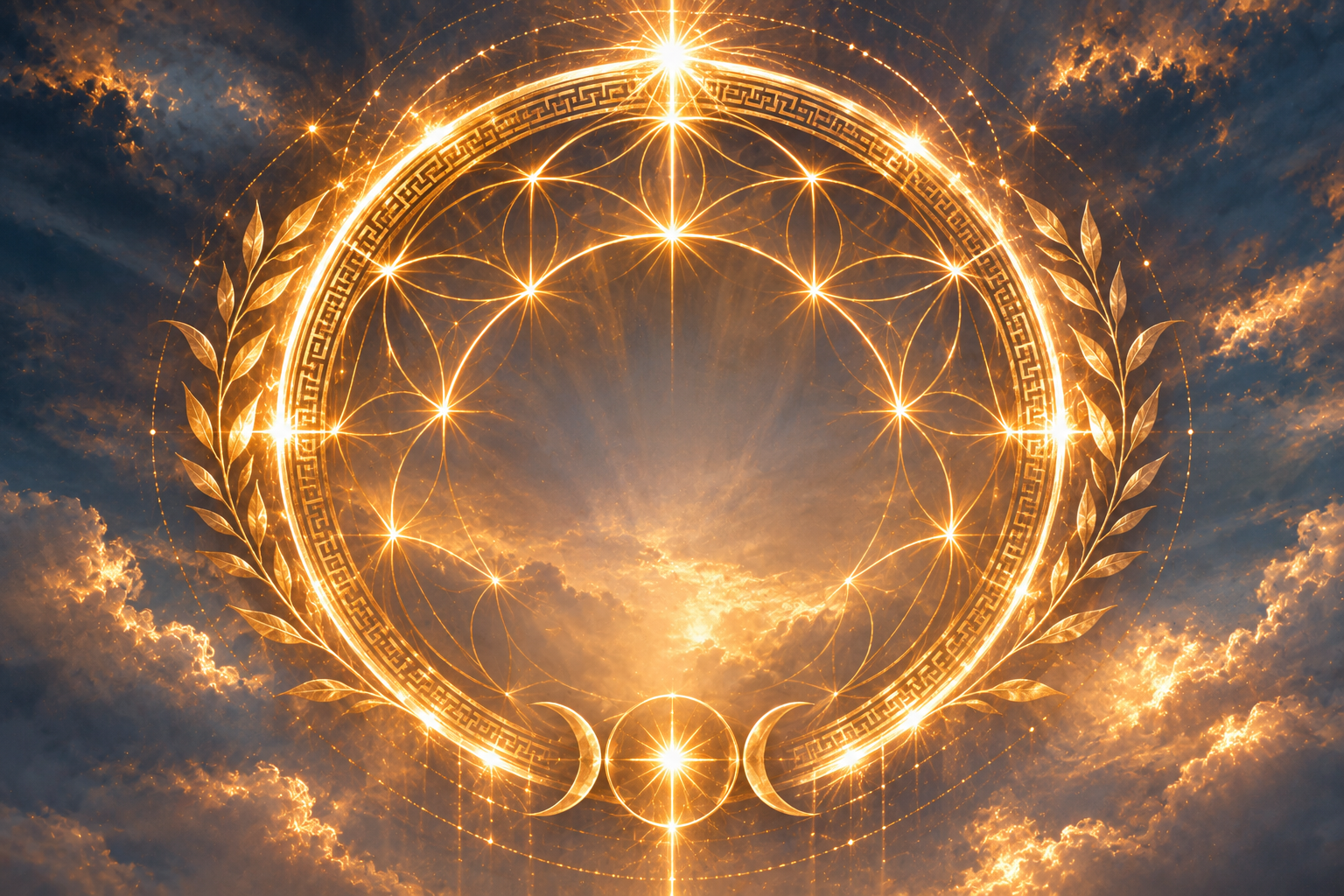
On ancient gods, sacred circles, and the curious business of being holy.
I always thought halos belonged above our heads. Specifically, not my head… the heads of Very Good people. Saints. Angels. Jesus. Occasionally a particularly well-behaved cartoon character.
Certainly not witches. Which is interesting, because the halo symbolism is actually much older than the Christian saints who made it famous.
And the word itself? Oh, this is good.
Before It Was Holy, It Was Dirt
Halo comes from the ancient Greek hálōs, meaning a circular threshing floor. A threshing floor.

The place where farmers separated grain from its husks. Often circular, worn into the earth by animals walking round and round.
Eventually, the word also described the disk of the sun or moon and the luminous rings appearing around them.

From a circle in the dirt to a circle in the heavens. And eventually, a circle around the heads of gods.
That is a spectacular career trajectory for a piece of agricultural vocabulary. But I love that the word began with ordinary work. Feet on the earth. Grain being separated from chaff. Something useful emerging from something that needed to be broken apart.
I could get philosophical about that… so I’m going to.
But first, we need to meet some very old gods.
The Sun Had It First
The halo is sometimes called humanity’s oldest spiritual symbol. As lovely a claim as that is, it’s not quite one we can prove. Humans were making symbolic images long before the halo appeared in its recognizable artistic form. But the idea behind it is extraordinarily ancient.
Light. The sun rises. Darkness retreats. Plants grow. Animals stir. People wake up and get on with the exhausting business of being alive. We didn’t need theology to recognize that the sun was important. We just had to be cold.
Ancient Egypt:

The disk generally sat above their heads rather than behind them, but the symbolism is unmistakable.
Divinity. Power. Life-giving light.
In the religious art of ancient Iran, we find early examples of the circular halo behind the head.

And then the symbol traveled. Across trade routes. Across kingdoms. Across cultures that didn’t always agree about much of anything.
The Buddha acquired a halo.

Greek and Roman solar deities radiated light.

Hindu deities appeared surrounded by brilliance.


Apparently, the gods had discovered a universally effective accessory. Here’s what fascinates me. These traditions had different understandings of God, salvation, enlightenment, and the nature of existence. But they kept returning to the same visual language.
Light emanation means something. Not necessarily the same thing. But something important.
The Halo Wasn’t Always About Being Good
This is where the story gets interesting. We tend to think of halos as moral certifications. Good person. Holy person. Safe person. Congratulations. Here’s your shiny circle hat.
But historically, halos have represented all sorts of powerful concepts. Divinity, spiritual radiance, enlightenment, authority, royal power, and sacred importance to name a few. And these are not interchangeable concepts.

The halo wasn’t always saying, “This person is good.” Sometimes it was saying, “This person matters.” And sometimes, perhaps, “This person would very much like you to believe they matter.”
Which brings us to a wonderful modern complication.
The Halo Effect: When Our Brains Get Involved
Psychology has its own halo.

Someone is beautiful, so we assume they’re kind.
Someone is charming, so we assume they’re trustworthy.
Someone speaks with confidence, so we assume they know what the hell they’re talking about.
They may. They may not. Our brains have simply taken one pretty characteristic and illuminated everything around it with possibly dangerous assumptions.

I find this deliciously ironic. Human beings spent centuries painting halos around the heads of people they considered exceptional. Then modern psychology rolls in and explains how easily we put imaginary ones there ourselves. We don’t even need the gold paint.
This is also where humility becomes useful. The kind of humility that keeps not just oneself ‘right sized’, but our fellows as well. Not the kind that demands we think less of ourselves, but the kind that reminds us that admiration is not evidence of perfection.
Including when the person looking pretty is ourselves. Or, let’s be real, especially then.
And Then There’s the Actual Halo
Because nature, as usual, has been doing something spectacular without consulting our religious authorities. Real halos appear around the sun and moon. They are atmospheric optical phenomena, often formed when light passes through tiny ice crystals suspended high in the atmosphere. The crystals bend and redirect the light, sometimes producing an enormous luminous ring. A common variety is called the 22-degree halo, named for its angular radius.

No angels required. No divine permission slip. Just sunlight, ice, geometry, and an observer standing in precisely the right relationship to them and we see a magnificent halo in all it’s glory circling celestial bodies.
Just magnificent in itself. Explaining the mechanism makes it more amazing, not less divine. The universe can produce something that looks like a religious revelation using frozen water and a little physics. One doesn’t have to be a believer to feel something sacred.
So What Does a Halo Mean to a Witch?
I’ve recently found myself becoming rather witchy. Check out these receipts: There is a cat. There’s a spider. An increasing interest in old symbols, intuition, and the extraordinary things we once understood through mythology because we hadn’t yet invented the necessary scientific vocabulary. (Check me out with a jumping spider, whofrigginknew…)

What exactly is a witch in today’s culture? Historically, the definition has often depended on who was accusing her. What I’ve become interested in is something beyond spells and clairvoyance: the possibility that enlightenment isn’t a matter of years of disciplined training.
What if it’s a matter of paying attention? And what if the halo is trying to tell us something about what happens when we do? I’m fascinated that so many different cultures found a circle of light useful for expressing something they considered extraordinary.
Was it simply the most obvious way to illustrate divinity? After all, the sun is a pretty compelling example of power. Or were they attempting to communicate an experience?
A sense of illumination. Of consciousness expanding. Of something becoming visible that had previously been hidden.

Maybe what they called divine light was an experience of the nervous system. Maybe it was a spiritual encounter. Maybe our modern distinction between those two explanations isn’t nearly as useful as we imagine.
I don’t know. And I’m increasingly comfortable with that. But I do wonder whether we’ve become so accustomed to seeing halos in religious art that we’ve stopped asking what the artists believed they were showing us. Especially for a woman who has become rather fond of investigating the things she was once content to dismiss.
I’m not ready to claim that people literally radiate enlightenment. But I’m certainly not ready to conclude that thousands of years of human fascination with spiritual illumination have nothing left to teach us.
Amy Dinaburg, Philosopher
Retired ER RN, MS (Molecular Biology)


Leave a Reply