
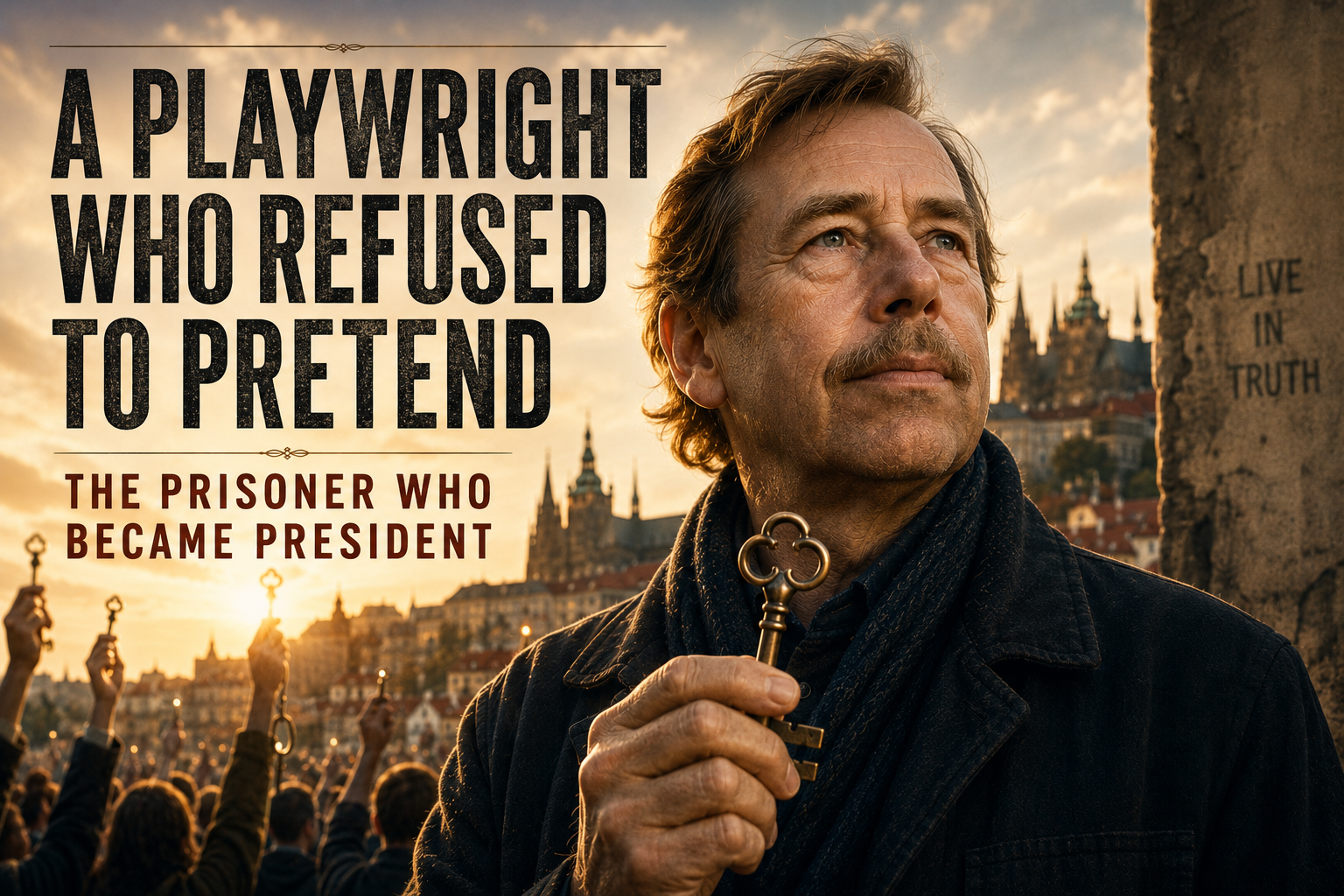
Vaclav Havel and the Cost of Living in Truth
Imagine being sent to prison for speaking openly about what everyone can already see. Then imagine living long enough to watch the system that imprisoned you collapse.
Finally, imagine the people turning to you and saying, “Now you lead.”
That sounds like fiction. For Vaclav Havel, it was biography.
Most Americans have never heard of him. Which is strange. Because his story may be one of the most hopeful political stories of the twentieth century.

Perhaps that made him uniquely qualified to recognize what was happening around him. Havel lived in communist Czechoslovakia during a period when public life had become a kind of theater.
Certain things were expected to be said. Public praise for the Communist Party, confidence in the success of socialism, and loyalty to the state were treated as normal civic duties—even by people who privately harbored doubts.
Certain ideas could not be questioned. Whether the Communist Party deserved a monopoly on power, whether citizens should have free elections, or whether people should be allowed to openly criticize their government were dangerous questions to ask. Raising them could cost someone a career, a publishing contract, years of surveillance, or even imprisonment.
Certain opinions had to be performed. Many people learned to applaud speeches they didn’t believe, repeat slogans they hadn’t chosen, and publicly agree with ideas they discussed very differently behind closed doors. The performance itself became a kind of social currency.

What fascinated him was not the leaders at the top.
It was the countless ordinary people participating in something they knew wasn’t entirely true.
One of his most famous examples involved a greengrocer. A shopkeeper places a political slogan in his window. Not because he believes it. Not because anyone else believes it.

Havel believed oppressive systems survive partly because of these tiny daily performances. Not because everyone is remotely convinced.
Because everyone is participating.
That idea struck me harder than I expected. Because it is not really about communism. It is about human beings. How often do we defend ideas we secretly doubt? How often do we repeat things because everyone around us seems to agree? How often do we maintain an image long after reality has moved on?
These are uncomfortable questions.
Havel asked them anyway. The government was not amused.
His writings were banned.
His plays were restricted.
He was monitored.
Harassed.
Arrested.
Eventually imprisoned.

There was no guarantee history would reward him.
No promise that the truth would prevail.
No assurance that his sacrifices would matter.
That is what makes his courage meaningful. He acted before success was visible. He acted when failure seemed far more likely.
Years passed. The cracks began to spread. The Soviet bloc… weakened. Citizens who had quietly carried the weight of silence for decades began finding their voices. Then came the Velvet Revolution. Mass demonstrations filled the streets. The regime that had once seemed permanent suddenly appeared fragile.
Within weeks, the impossible became reality.
The playwright.
The dissident.
The prisoner.
Became president.
It wasn’t an accident. For years, Havel had been quietly gathering something far more valuable than political power.
Trust.
When the communist government jailed him, it also revealed what it feared most. Not an army. Not a wealthy rival. A writer whose words kept helping people describe what they already knew but struggled to say aloud.
In 1977, Havel became one of the principal authors and spokesmen for Charter 77, a document that did something almost embarrassingly simple: it asked the government to honor the human rights agreements it had already signed. That was enough. The state responded with surveillance, interrogations, harassment, and imprisonment. Havel spent years paying the price for insisting that a government should keep its own promises.

Then history shifted.
In late 1989, peaceful demonstrations spread across Czechoslovakia. Students marched. Workers joined them. Hundreds of thousands filled the streets carrying candles, jingling keys, and calling for change. The movement became known as the Velvet Revolution because, remarkably, the regime collapsed with very little bloodshed.

Within weeks of the revolution, the imprisoned playwright was elected president. He did not conquer the country. The country handed him its future.
Then came the harder part. Winning trust is one thing. Governing is harder.
Havel inherited a country emerging from four decades of communist rule. There was no instruction manual for what came next. Institutions had to be rebuilt. Markets had to be created. Laws had to be rewritten. Citizens who had spent years distrusting their government now had to learn how to participate in one.
He was never the country’s chief economic architect. That role belonged largely to others, especially Prime Minister Václav Klaus, who championed rapid free-market reforms. Havel’s focus was different. He worried that if a nation rebuilt its economy without rebuilding its civic life, corruption and cynicism would simply find new disguises.

He believed free markets needed strong institutions, an independent judiciary, a free press, and an active civil society if freedom was going to last.
He wasn’t always right and he made some mistakes.
He couldn’t prevent the peaceful split of Czechoslovakia into the Czech Republic and Slovakia in 1993, something that deeply saddened him. He was criticized for being too idealistic, too philosophical, and sometimes too detached from the practical horse-trading of politics. By the end of his presidency, he was often more admired abroad than at home.
But something remarkable happened anyway.


The Sound of Keys
History remembers many revolutions by the weapons they carried.
The Velvet Revolution is remembered, in part, by ordinary house keys. As hundreds of thousands of Czechoslovakians gathered peacefully in November 1989, they raised their keys into the air and jingled them together. The sound rolled across Prague.
Not bullets.
Not bombs.
Keys.
The message was simple.
“Your time is over.”
But there was another message hidden inside the first. Keys don’t merely lock doors. They unlock them. It wasn’t the key to a palace… or a prison… or a government building. It was an ordinary house key.
The kind carried by teachers.
Factory workers.
Students.
Parents.
Neighbors.
History often remembers extraordinary people. Perhaps it should also remember the ordinary things that helped them change the world.
The Czech Republic became a stable parliamentary democracy, joined NATO during Havel’s presidency, and began the process that would lead to membership in the European Union after he left office.
History has a funny way of grading people.
Some leaders are celebrated while they hold office and forgotten afterward.
Others spend years frustrating everyone around them, only to have history quietly whisper:
“He saw something important.”
Havel’s greatest success may not have been a particular law or economic policy.
It may have been helping a nation remember that politics is supposed to serve human dignity—not the other way around.
That is a difficult legacy to measure. It is also one that has aged remarkably well.

If a novelist submitted that plot, an editor might reject it for being unrealistic. Yet here we are.
What interests me most is not that Havel became president. It is what got him imprisoned in the first place. He refused to participate in a collective fiction. He refused to say what he did not believe. He refused to pretend. That sounds simple.
Until the cost becomes real.
Until friendships are at risk.
Until careers are at risk.
Until comfort is at risk.
Until freedom itself is at risk.
Then we discover how difficult truth can be. And how preciously valuable.
Havel was not perfect. He made mistakes. His critics found plenty to criticize. As they should.

He chose honesty over performance.
Again and again.
That’s why his story still matters. Not because he defeated a megalo-enemy. Not because he won a tight election. Not because he became The last President of Czechoslovakia (1989–1992) and The first President of the Czech Republic (1993–2003), after the peaceful split of Czechoslovakia into the Czech Republic and Slovakia (the “Velvet Divorce”).
Because he reminds us that history is not fixed.

The future has a strange habit of surprising those who believe nothing can change. Vaclav Havel understood something worth remembering. Oppression depends upon many things. But truth has a stubbornness of its own.
And sometimes the simple act of refusing to pretend becomes the first crack in a wall everyone thought would stand forever.
Amy Dinaburg, Philosopher, Retired ER RN, MS (Molecular Biology)
Subscribe for notifications of new releases.


Leave a Reply