
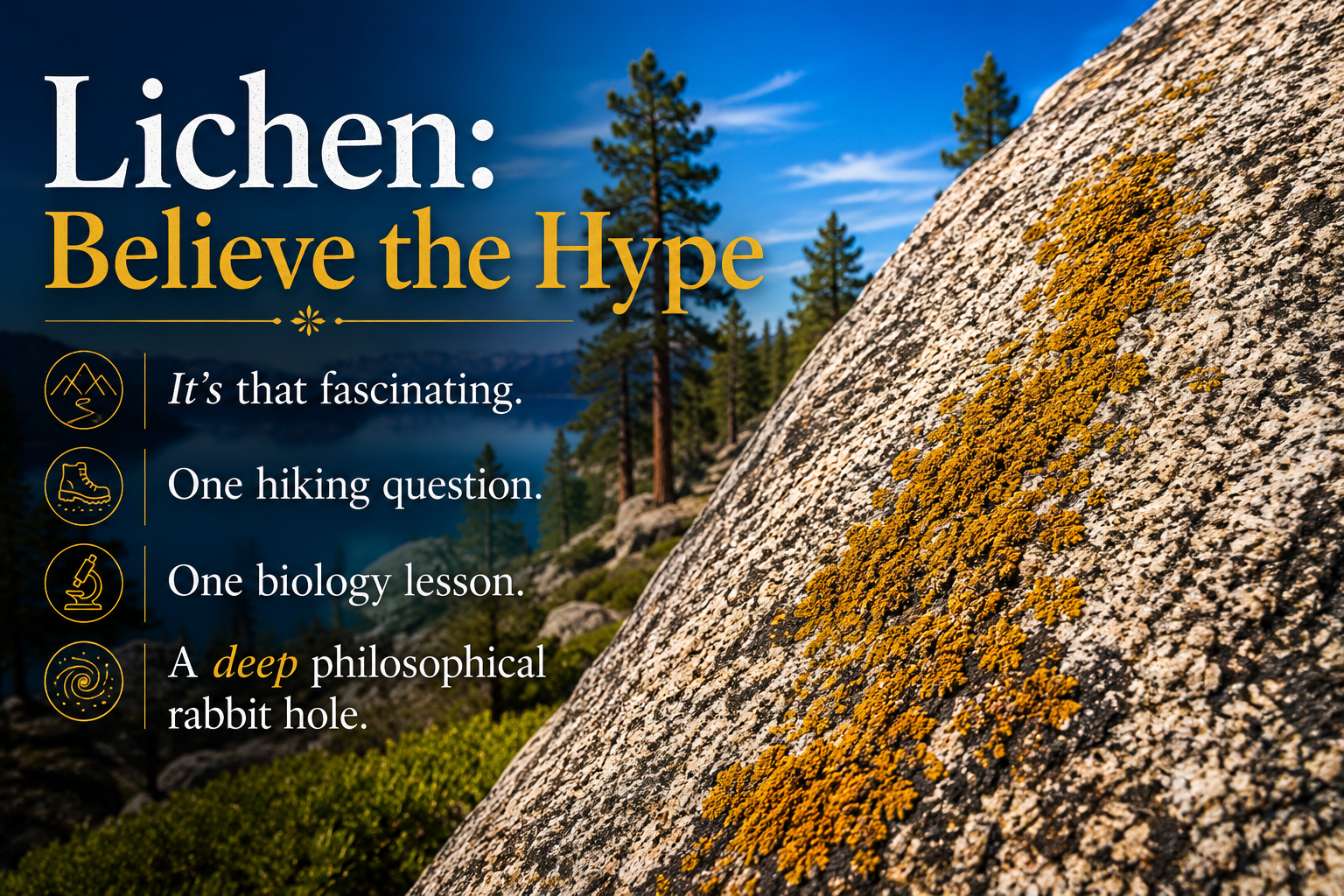
How a simple hiking question turned into one of the strangest stories in biology and philosophy
On a hike through the Sierra Nevada, our guide pointed to two patches growing on nearby rocks.


“That’s moss,” he said. “And that’s lichen.”
I realized I had absolutely no idea what the difference was.
I assumed one was just greener than the other. Maybe one liked shade. Maybe one liked sun.
It seemed like the sort of fact I’d forget before we reached the next overlook.
Instead…
I accidentally unearthed an entire civilization. Hear me out.
At first, the answer was simple enough.
Moss is a plant.
Lichen isn’t.
Easy.
Next question.
Except… what is lichen? The more I read, the stranger the answer became.
I kept waiting for someone to write: “Lichen is a…”
They never really did. Instead they kept writing things like…
“A partnership…”
“A symbiosis…”
“A community…”
Which felt suspiciously unlike an answer.
For decades, textbooks offered a tidy explanation. A fungus met an alga. The fungus provided shelter. The alga captured sunlight and made food. Together, they formed a lichen.
Simple.

Except…
Biology has a habit of making simple stories wonderfully inconvenient.
As scientists began sequencing DNA, they kept finding more partners hiding in plain sight.
Many lichens contain bacteria.

Some include specialized yeasts.

Others host additional microscopic organisms whose roles scientists are still trying to understand. The deeper researchers looked, the busier the neighborhood became.
That doesn’t mean every lichen contains the exact same cast of characters. Different species build different partnerships. The story is still unfolding. Which somehow makes it even better.
Here’s the part that completely rewired my brain. The fungus can often live without the alga. The alga can often live without the fungus. But if you separate them…
The lichen disappears. Think about that for a second. The pieces remain. The thing itself does not.

Or maybe it’s closer to water. Hydrogen exists. Oxygen exists.
Bring them together in just the right way… and you’ve created something neither one was before.
Lichens don’t just share space. They create a new reality for themselves.
And somehow… that wasn’t even the strangest part.
Lichens are among the toughest living things on Earth.
Some survive blistering deserts.

Others thrive in the Arctic.

Several species have survived direct exposure to the vacuum of space during experiments outside the International Space Station. Not forever. But long enough to astonish everyone.

When conditions become too dry, many lichens don’t die. They wait. Their metabolism slows to nearly nothing.
Months can pass. Then rain falls. Within minutes, they’re awake again.

They also possess a superpower so quiet that most hikers never notice it. They’re making dirt.

Tiny acids released by the fungus slowly dissolve minerals from the rock. Not dramatically. Patiently. One grain at a time.
Dust gathers.
Moisture lingers.
Tiny pockets form.
Eventually moss arrives.
Then grasses.
Then shrubs.
Eventually…
Forests.

One of my favorite discoveries came almost by accident. Scientists who study lichens have a reputation. They’re wonderfully obsessed. The kind of people who happily spend an afternoon staring at a boulder while everyone else walks by. I used to think that sounded eccentric. Now I’m not so sure.
I thought I was learning the difference between moss and lichen.
Instead… I found myself asking a question I never expected.
What is one?

Is a lichen one organism? Several organisms? A community? A partnership?
Biologists are still refining the language because the biology refuses to fit neatly inside our categories.
Maybe that’s why I couldn’t stop thinking about it.
Not because lichen answered the question.
Because it made the question impossible to ignore.
For most of my life, “one” felt obvious.
One tree.
One person.
One organism.
One forest.
Now I’m not so sure.
Perhaps the most humbling discoveries aren’t the ones that give us better answers. They’re the ones that quietly reveal we’ve been asking the wrong question all along. I started a hike wondering about the difference between moss and lichen.
I came home wondering…
What, exactly, does it mean to be one?
Amy Dinaburg, Philosopher, Retired RN, MS (Molecular Biology)


Leave a Reply