
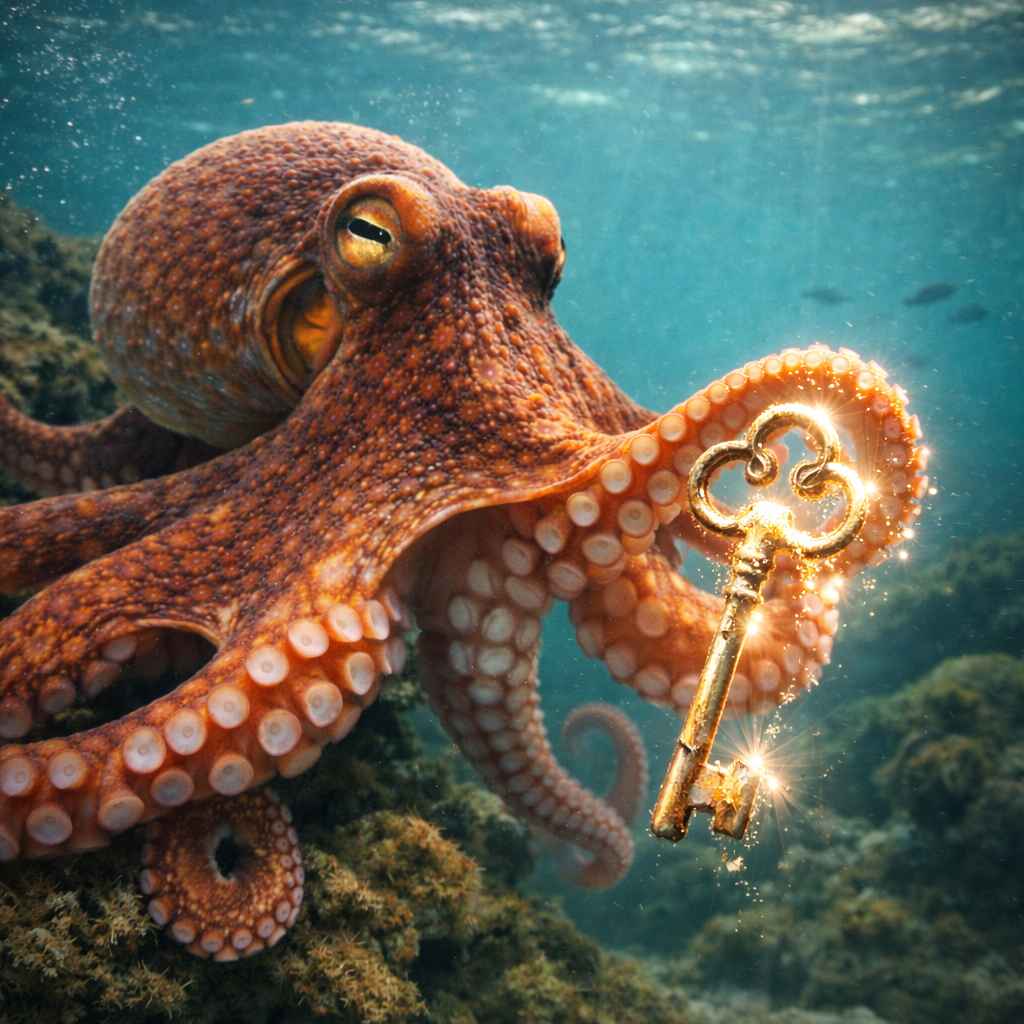
We tend to explain the octopus by listing its features.
Eight arms.
Chromophores that shift color in an instant.
Roughly 500 million neurons—comparable to a dog.
And it’s true—each of those is remarkable.
But features alone don’t explain advantage.
Evolution doesn’t select for what is interesting.
It selects for what works.

So it’s worth asking a different question:
What if the real advantage isn’t any one of these traits…
but the way they work together?
An octopus does not think the way we do.
It has a central brain, yes—but most of its neurons are not located there.
Roughly two-thirds are distributed throughout its arms.

Each arm has its own brain and can sense, explore, and act with a degree of independence.
Researchers often describe this as a form of distributed or embodied intelligence-
a system where control is not purely centralized, but shared across the body itself (Hochner, 2012).
In this kind of organism, behavior is not simply commanded.
It is coordinated.
Watch how an octopus moves.
One arm explores.
Another pauses.
Another reaches further than the rest.
It doesn’t look like a single plan being executed.
It looks like something… negotiating.

And yet—
it doesn’t fall apart.
It doesn’t freeze.
It doesn’t collapse under competing inputs.
Somehow, all of these semi-independent actions
still resolve into one coherent movement.
The octopus gets where it’s going.

In controlled studies, octopuses have shown consistent preferences for using particular arms when reaching for food—a phenomenon sometimes compared to handedness in humans (Byrne et al., 2006).
Other observations suggest that different arms may take on different roles depending on the situation. Some initiate exploration. Others stabilize. Others contribute to movement.
Researchers describe this in terms of functional specialization and distributed control.
But from the outside, it can feel like something more.
At times, different arms appear to respond differently to the same moment—
some reaching, some hesitating, some engaging more readily than others.
Not personalities in the human sense. I’m not suggesting that each arm has a specific name with a personality and negotiates in the committee. But I am suggesting a rudimentary form of this system. And rudimentary forms are evolution’s playground.
There appears to be enough variation in each arm to suggest that behavior, even within a single organism,
is not always singular.

Most explanations stop here.
Coordination.
Integration.
Distributed processing.
But what if that’s not the full story?
Imagine a team under constant pressure.
High stakes.
Limited time.
No room for hesitation.
Over time, that team learns something subtle but powerful:
how to move together.
Not perfectly.
Not identically.
But with enough shared direction
that decisions happen faster,
responses become fluid,
and coordination starts to feel almost instinctive.
I’ve worked as an RN in an emergency department. I have seen this and have been a part of it.
Communication becomes minimal.
People anticipate rather than react.
From the outside, it can look almost like telepathy.
Now imagine that evolutionary pressure not acting on a group of individuals—
but on a single organism
with multiple semi-independent parts.

Over time, what gets selected?
Not just strength.
Not just speed.

But the ability of those parts
to work together efficiently enough to function as one.
The octopus is not nine individuals in a room.
Its arms do not have names.
They are not separate minds.
But it may represent something like a rudimentary version
of what highly integrated systems can become.
Not identical parts.
Not perfectly controlled parts.
But coordinated parts—
shaped, over time, to contribute to the same outcome.

Scientists don’t argue that octopuses evolved intelligence because of internal teamwork. The leading explanations point to ecological pressures—loss of a protective shell, exposure to predators, and the need for flexible, adaptive behavior (Mather, 2017).
But those pressures acted on a very unusual body.
One with eight flexible, sensing, semi-autonomous arms.

It’s not unreasonable to ask:
Did this body simply require intelligence—
or did it help shape the kind of intelligence that emerged?
Is integration power (9 “individuals” in your body that are amazing at working together) an evolutionary advantage that helped the octopus get where it can solve problems that teamwork would be an advantage… like figuring out how to unscrew a jar from the inside.
If intelligence were only about neuron count,
the octopus would already be impressive.
But it may have something else.
Not just processing power—
but this integration advantage.
And this is where the question gets uncomfortably close to home.
Because humans don’t just think.
We also negotiate.
Part of you wants discipline.
Part of you wants comfort.
Part of you wants connection.
Part of you wants to be left alone.
We don’t lack intelligence.
We often lack alignment.
And sometimes, we actively make that harder.
We ignore sleep.


We neglect movement.
We eat in ways that work against our biology.


We live in chronic stress and call it normal.
Then we ask why we feel scattered.
Why we can’t focus.
Why we don’t feel like ourselves.
It’s not just psychological.
It’s biological.
The system itself is harder to integrate
when the conditions it depends on are unstable.
The octopus doesn’t need perfect agreement to function.
It needs enough alignment
that its many parts can move in the same direction
more often than they pull apart.
And through that—
it becomes something remarkably capable.
This is not a proven theory.
No one is claiming an octopus is a team in the way humans understand teams.
But the possibility is worth sitting with:
That the advantage we’re noticing
might not only be intelligence—
but the ability of a system to align with itself under pressure.
Even if its parts are not identical.
Even if they don’t always agree.
Even if…
they’re all you.
If octopi, evolution, and philosophy jazz you as much as they do me (which if you’re still reading, they must), please consider subscribing for notifications of new releases (and to help my algorithm). Thank you.
References
Byrne, R.A., Kuba, M.J., & Griebel, U. (2006). Lateral asymmetry of eye use in Octopus vulgaris.
Hochner, B. (2012). An embodied view of octopus neurobiology. Current Biology
Mather, J.A. (2017). Cephalopod cognition.


Leave a Reply